
Gardena Wood Flooring installs wide plank hardwood flooring in Gardena, CA, serving surrounding cities including Alondra Park, West Athens, West Rancho Dominguez, Lawndale and Hawthorne. We also lay herringbone and chevron patterns, which share the same demand for careful preparation and a lot more handwork than a standard straight-laid floor.
Wide boards show more of the wood’s grain and make a room feel larger and calmer. They also move more with humidity, so the things that are good practice on any floor, such as acclimation, moisture testing and the right fastening, stop being optional. After 20+ years of installations, we plan wide plank jobs around that movement from the start. This page covers how wide boards behave, choosing between solid and engineered construction, species and grade, and what goes into laying a herringbone or chevron floor.
Why Wide Planks Behave Differently
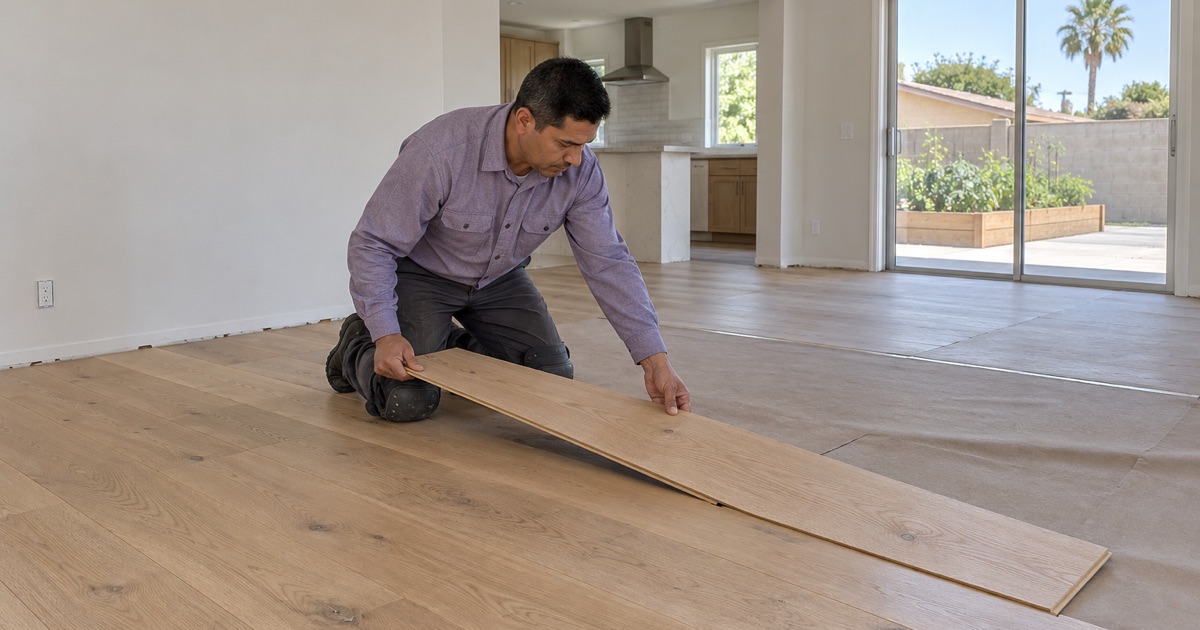
Movement Across the Width
Wood expands and contracts across its width as its moisture content changes, and a wide board has more width to move. A gap between two narrow strips that nobody would notice becomes a visible line between two wide planks, and a floor that is slightly damp from below cups more obviously.
That movement is not a defect in the wood. It is something to plan for, through acclimation, a dry and stable subfloor, and an expansion gap around the room.
Acclimation and Moisture Testing
We measure the moisture content of the new boards and the subfloor with a wood moisture meter, and install only when the two are close to each other and to the conditions the room will see. On concrete, we test the slab with an ASTM F2170 in-situ relative humidity test or a calcium chloride moisture test before choosing the product.
The readings are recorded on the day installation begins. With wide planks, a mismatch that a narrow floor might absorb shows up as cupping or gapping within a season.
Fastening for Width
Solid wide planks are usually nailed through the tongue and often glued to the subfloor as well, which helps hold the board flat across its width. Engineered wide planks can be glued down or floated depending on the product and subfloor. We follow the manufacturer’s instructions and NWFA installation guidelines for fastener spacing, adhesive and expansion gaps, because wide boards leave less margin for shortcuts than narrow ones.
Solid or Engineered Wide Plank
Engineered Wide Plank
Engineered construction bonds a real wood wear layer to a cross-laid core that resists movement. That makes wide engineered planks much more stable than solid boards of the same width, and it is the usual choice over a concrete slab-on-grade.
The wear layer thickness matters just as much on a wide plank as on any engineered floor. A thicker layer leaves room for a full sanding later, which is worth paying for on a floor you expect to keep.
Solid Wide Plank
Solid wide planks suit a house on a raised foundation with sound plywood or plank decking, where they can be nailed and glued to the subfloor. They can be sanded many times over their life and have a weight and feel underfoot that some owners prefer.
They are also the least forgiving floor if moisture is not controlled. We check the crawl space and the subfloor carefully before recommending solid wide planks.
Species, Grade and Finish
White Oak and Other Species
White oak is the most common choice for wide plank floors. It is harder than red oak on the Janka hardness scale, takes stain evenly, and its grain looks natural across a wide face. Hickory offers more hardness and strong color variation, maple is hard with a quiet grain, and walnut gives a rich dark tone but dents more easily.
We show finished samples of each species at the width you are considering, because grain that looks busy on a narrow sample can look calm on a wide one, and the reverse.
Grade and Character
Grade describes how much natural character the boards carry: knots, color variation and mineral streaks. Clear grades look uniform and formal, while character grades show more of the tree and hide wear better in a busy house. Wide planks show character more than narrow boards do, so it is worth looking at a few full-length boards of the grade before ordering.
Finish and Sheen
Most wide plank floors look best in a matte or satin sheen, which shows the grain rather than reflections. We use finishes at or under the 275 g/L limit set by SCAQMD Rule 1113, and a hardwax oil finish is an option for owners who prefer a natural look and are happy with more regular maintenance.
Herringbone and Chevron Floors
How the Patterns Differ
Herringbone pattern flooring uses rectangular boards laid at right angles, with the end of each board meeting the side of the next to form a stepped zigzag. Chevron pattern boards are cut at an angle on their ends, so they meet in a clean point and form a continuous V down the room. Both work in solid or engineered wood, and many products are sold in left and right boards made specifically for the pattern.
Setting Out the Layout
A patterned floor is only as straight as its first line. We find the room’s centerline and main sightline, snap a layout line, and build the pattern out from there so it runs true through doorways and looks centered from the entry.
Once the field is down, every board at the walls, thresholds and around cabinets is cut and fitted individually, often finished with a border of straight boards around the room’s edge.
Time and Cost
Patterned floors take considerably longer than straight-laid floors, because every board is placed individually and there are far more cuts. The price reflects that labor, and we give it to you in writing after measuring the rooms and agreeing where the pattern starts and how it meets the rooms around it.
- 20+ Years in Business
- Written Moisture Readings
- Lead-Safe Work Practices