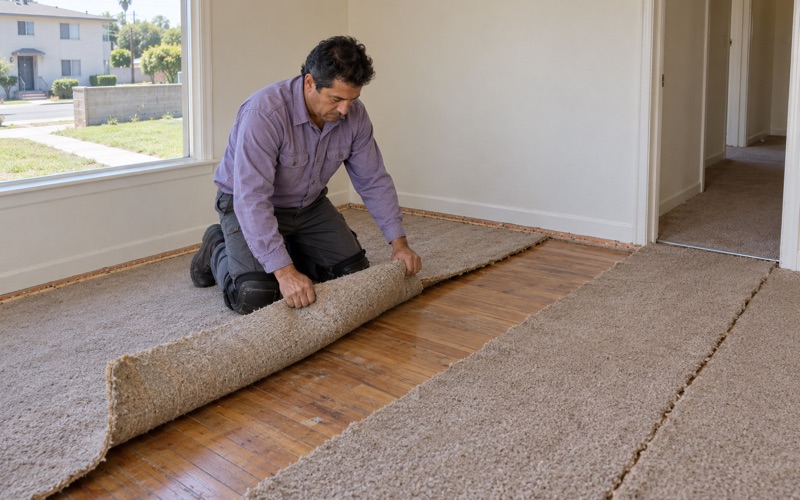
Gardena Wood Flooring brings 20+ years of experience to wood-flooring in Westmont, and a large share of our work here happens in rental units rather than owner-occupied houses. Landlords call us when a tenant moves out, when an inspection date is on the calendar, or when a floor has worn past the point where a new lease can reasonably start on it.
Much of that work involves units rented through the Housing Choice Voucher program. A voucher unit has to pass the housing authority’s inspection before the lease begins and again while the tenancy runs, so the floor is not a cosmetic question for these owners. A torn transition, a lifted board or a soft patch near the bathroom can hold up a move-in date.
This page is written for those owners. It covers what we check before an inspector walks the unit, how we repair floors between one voucher tenancy and the next, and which floor choices stand up to years of steady occupancy without turning every turnover into a replacement job.
Voucher Rentals Run Deep in Westmont
Westmont is an unincorporated community in Los Angeles County, and most of its households rent. Census estimates put the share at 71.7 percent, which shapes what flooring work here looks like.
Multi-Unit Buildings Carry the Rental Load
Of the renter households in Westmont, 4,633 live in buildings with two or more units, or 62.6 percent of all renters. Duplexes, fourplexes and small apartment buildings can mean a single owner manages several units with the same floors, the same age and the same wear patterns, which makes a repeatable repair plan worth more than a one-off fix.
The housing stock is old as well: 89.1 percent of Westmont’s units were built before 1990, and 21.8 percent date to 1939 or earlier. Floors in buildings that age have often been patched, covered and refinished more than once, so we expect layers and past repairs rather than a clean slate.
Where the Voucher Numbers Come From
HUD publishes voucher counts by census tract, with coverage through December 2025. In the tract at the center of Westmont, 373 households rent with Housing Choice Vouchers, about 22 percent of that tract’s renter-occupied units. That is one tract, not a total for the whole community, but it shows how routine voucher tenancies are on these blocks.
Nearby tracts in the same part of South Los Angeles ran from roughly 16 to 25 percent. Countywide, LACDA, the County’s development authority, administers about 28,000 Housing Choice Vouchers, so a Westmont landlord renting to a voucher holder is working inside a large program with inspections built into it.
Looking for wood-flooring closer to Del Aire? See Wood-Flooring in Del Aire.
What an Inspection Looks at Underfoot
We do not quote inspection standards, and we do not promise an outcome. What we do is walk a unit the way an inspector would, looking at the floor as a safety surface first and a finish second, and fix what a careful eye would stop on.
Trip Edges, Transitions and Loose Boards
Many of the problems we find in older rentals sit at the edges: a reducer strip that has worked loose at a doorway, a T-molding split where hardwood meets tile, or shoe molding pulled away and leaving a gap. Each is a small repair, but a raised edge in a hallway is exactly the kind of thing that catches a foot.
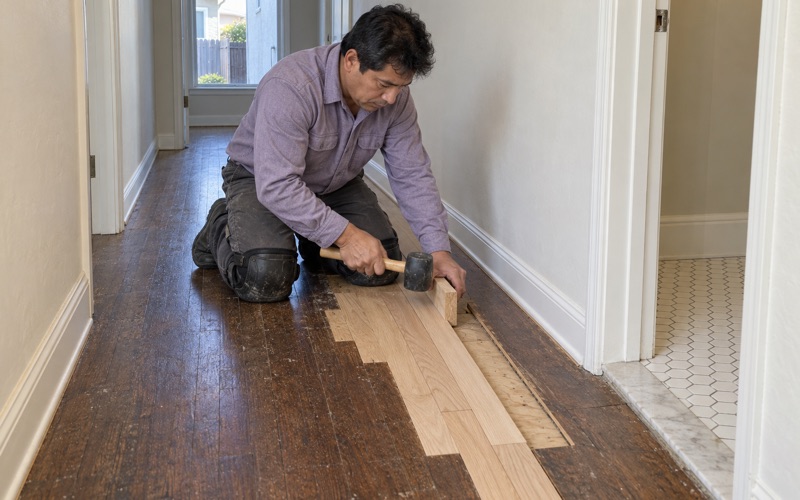
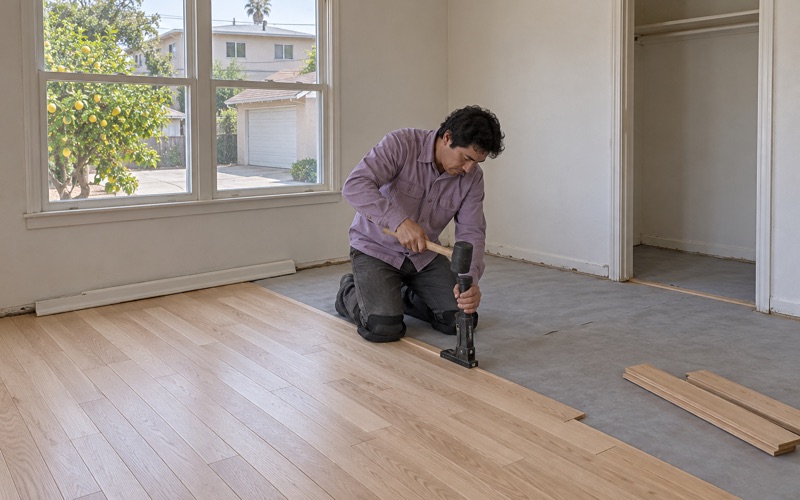
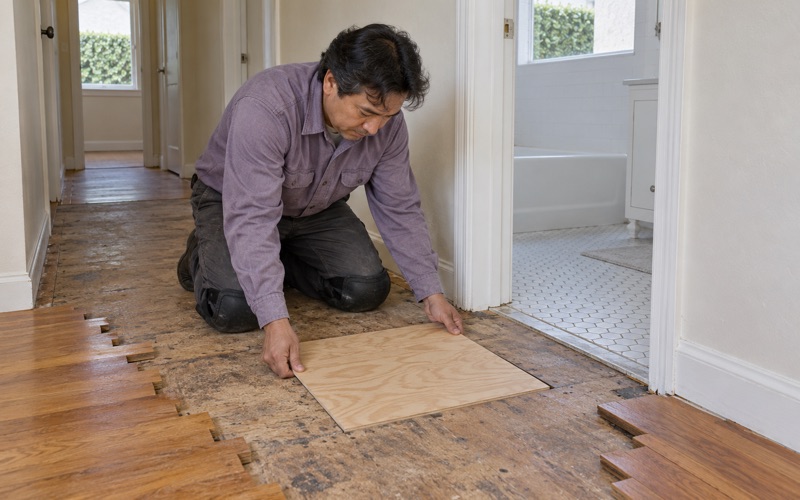
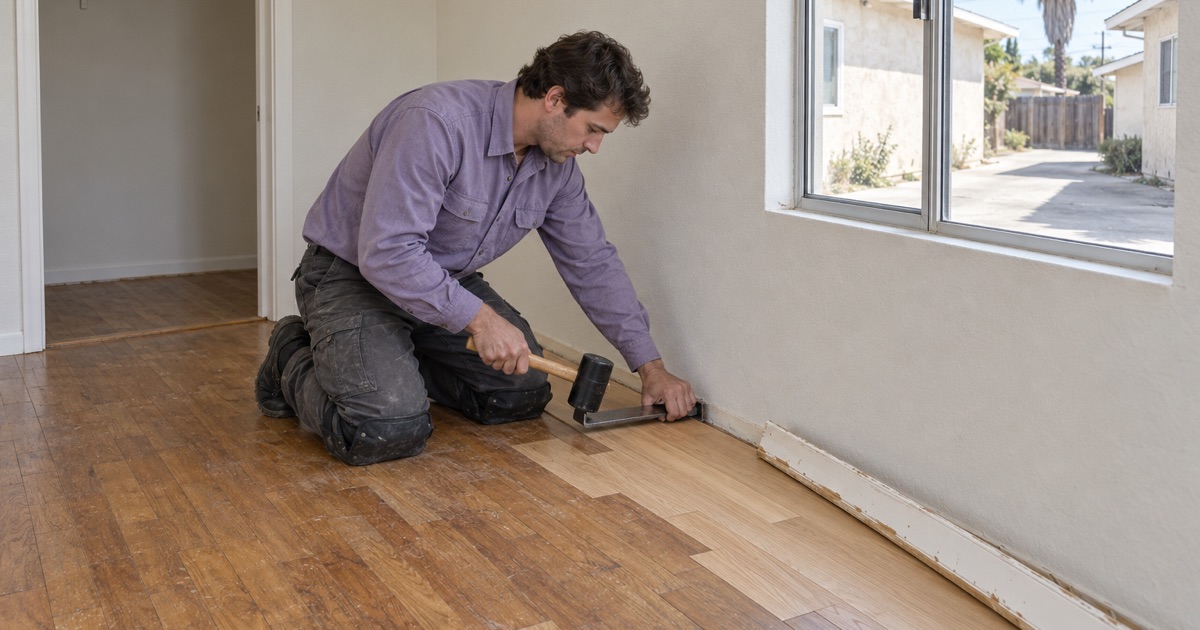
Loose boards are next. Nail pops, squeaks and boards that rock under weight often mean the fasteners have lost their grip in the floor decking. We refasten with cleat nails or a flooring staple, replace split boards with a weave-in repair so the new pieces follow the existing pattern, and leave the surface flat and tight.
Soft Spots and Hidden Water Damage
A floor that gives underfoot is a bigger conversation. Before we price any finish floor, we open the area and check what is underneath, because a soft spot can be water-swollen decking, a particleboard subfloor that has broken down, or a floor joist that needs sistering. Finding that before the lease starts is easier than finding it mid-tenancy.
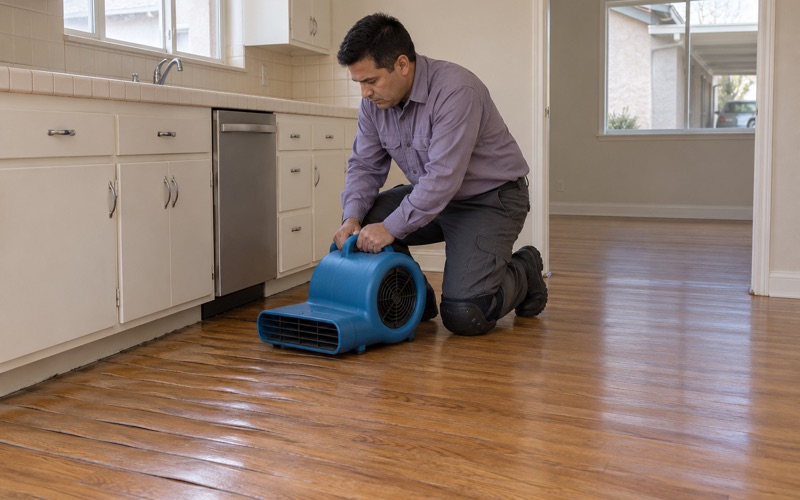
Soft areas near kitchens and bathrooms often trace back to a leak. We follow the damage to its source, whether a dishwasher supply line, a water heater or a slab leak, and document it with photos and wood moisture meter readings. That record matters if an insurance claim is involved, and it tells the owner whether the cause has actually been fixed.
Older Units, Lead Dust and Old Tile
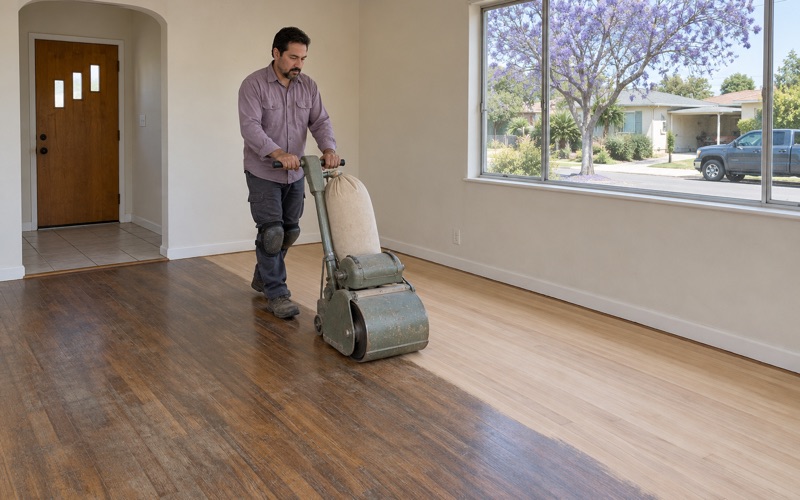
Most of Westmont’s units predate 1980, so we treat sanding in any pre-1978 building as lead-safe work under the EPA Renovation, Repair and Painting rule. Lead dust from sanding is a real hazard in a unit someone is about to live in, so we contain the work area, run a dustless sanding system and clean before handing the unit back.
Old flooring can hide another question. When we pull carpet or vinyl and find 9x9 floor tile or black mastic, we stop and treat it as a possible asbestos issue before anything is scraped or sanded, and we recommend an asbestos survey. It adds a step, but it keeps a routine turnover from becoming a contamination problem.
Repairing and Scheduling Between Voucher Tenancies
The window between one tenant leaving and the next lease starting is where most of this work happens. A plan that fits that window, and a paper trail that backs it up, matters as much as the repair itself.
Working a Building One Unit at a Time
In a triplex or fourplex, units rarely turn over together. We handle each one as its own job, with its own written estimate, so an owner can repair the unit that is vacant now and plan the others for when they open up. Where floors match across units, we note species, width and finish so later repairs blend in.
Repair comes before replacement in that conversation. A worn but sound hardwood floor can often be brought back with board replacement and a refinish, or with a fresh coat of finish if the wear is only on the surface. We give the owner that answer first, and only price new flooring when the existing floor cannot reasonably be saved.
Records a Landlord Can Keep
Every job ends with a written invoice that states what was repaired, where, and at what cost. When a departing tenant’s deposit is involved and California deposit law under Civil Code 1950.5 requires itemized repair costs, that paperwork is written so an owner can use it directly.
The same records help at inspection time. Dated photos, moisture readings and a note of what was fixed give an owner something to show if a floor question comes up, and a history to reference at the next routine visit. Unincorporated rentals are also subject to the County Rental Housing Habitability Program, which inspects every four years.
Timing Work Around the Inspection Date
Floor work should finish before the inspection, not the morning of it. We schedule the repair, the finish and the cure so the unit is dry, clean and fully walkable when the inspector arrives, and we give the owner a written cure schedule showing when each room can take foot traffic and when furniture can go back.
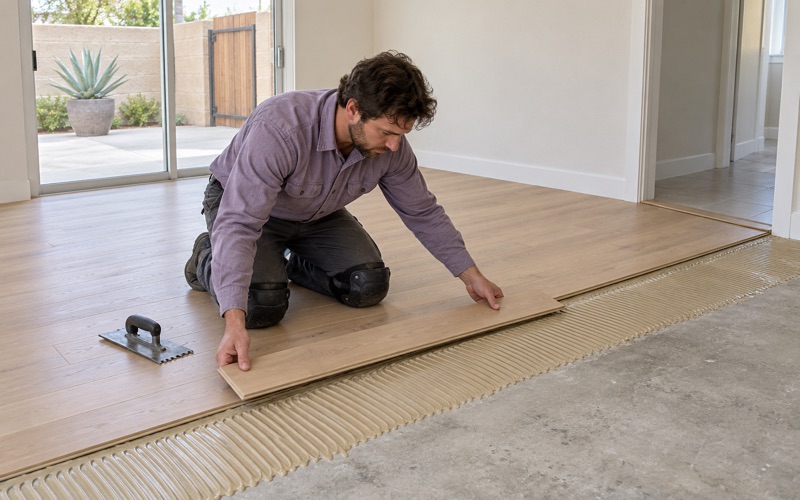
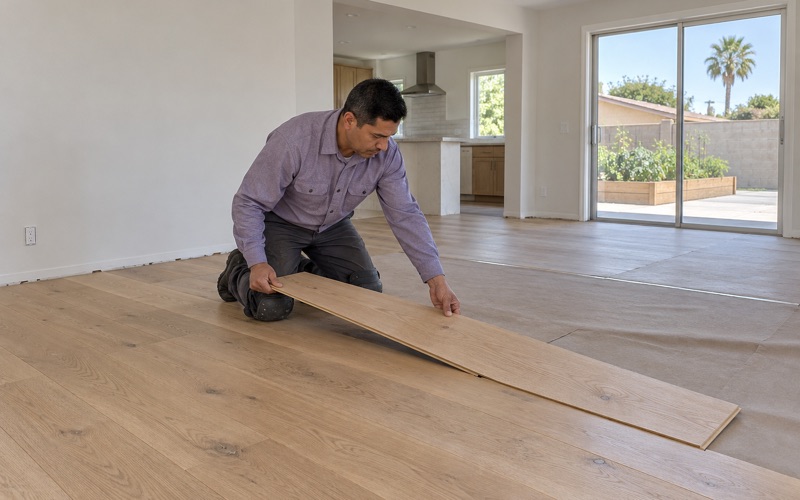
Replacement flooring needs lead time too. Wood has to reach the right moisture content and acclimate before installation, and if the unit sits on concrete we measure slab moisture before ordering material. Building those steps into the calendar helps keep a new floor from cupping or gapping a few months into the lease.
Floors That Hold Up in a Long Tenancy
Many Westmont renters stay put: census estimates count 4,257 renter households that moved in between 2010 and 2019. A floor chosen for a long tenancy should be judged on how it wears and how easily it can be renewed, not on how it looks on move-in day.
Species, Hardness and Wear Layer
For rental hallways and living rooms, we steer owners toward harder species. Red oak and white oak are dependable choices with good Janka hardness ratings, hickory and maple are harder still, and softer woods like walnut show dents quickly under daily traffic. In a long tenancy, the difference shows up as fewer boards to replace at each turnover.
If engineered flooring makes more sense, wear layer thickness is the number to ask about. A thicker wear layer can be sanded and refinished again later, while a thin one allows few or no full sandings. For units that will turn over many times, that future refinish is part of the value of the floor.
Finishes Chosen for Traffic and Air Rules
Westmont sits in the South Coast Air Quality Management District, so every finish we apply meets the 275 g/L VOC limit for wood coatings under SCAQMD Rule 1113. Within that limit, a commercial-grade waterborne polyurethane in a satin sheen is our usual rental recommendation: it cures quickly, holds up to traffic and hides everyday scuffs better than gloss.
The finish is also the cheapest thing to renew. A floor kept under a sound coat of polyurethane can often be refreshed with a screen and recoat between tenants rather than a full sand, which shortens the vacancy and keeps the wood itself from being thinned by repeated sanding.
Stairs, Entries and Where Wear Concentrates
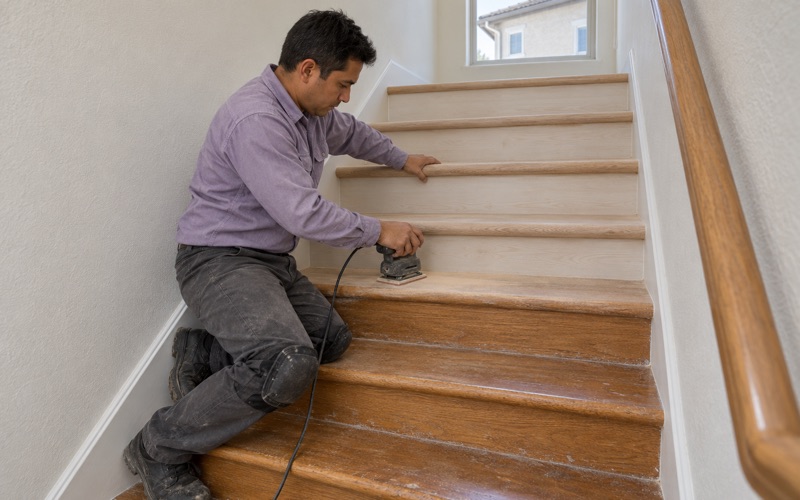
In two-story units and walk-up buildings, stairs take more wear than any room. We price stair work per tread and riser rather than folding it into a square-foot number, so an owner can see exactly what each flight costs and repair a worn stair nosing without redoing the whole staircase.
Entries and kitchen paths are the other pressure points. A durable finish there, a firmly fastened threshold and a tight transition to tile or vinyl do more for a long tenancy than an expensive species chosen for looks. Those are the details we check again at every turnover, because they are where a floor starts to fail first.
- 20+ Years in Business
- Written Moisture Readings
- Lead-Safe Work Practices