Gardena Wood Flooring brings more than 20 years of wood-flooring in West Carson and across the South Bay to every job, and a good share of the work here starts with a question most homeowners never expect: what kind of house is this, on paper? The answer changes who oversees the work, what gets checked first and which floor makes sense. We sort that out before we quote anything.
A conventional house and a factory-built home can look alike from the curb and still sit under different rules and different floor systems. So our first visit is part inspection and part paperwork: we look for the identifying labels, open the floor where it is soft or noisy, and measure moisture in the existing decking and any wood we plan to keep. Nothing gets priced until those readings are written down.
From there the job looks like any careful floor project: refinishing where a floor is worth saving, engineered or solid wood where replacement is the right call, dust containment in an occupied home and a written cure schedule so you know when each room can take furniture again. The difference is the homework that comes before it.
West Carson’s Mobile Home Parks and the June 15, 1976 Line
About One Home in Seven
West Carson is an unincorporated community in the South Bay part of Los Angeles County, and its housing is more varied than a drive down the main streets suggests. Census figures count 1,286 mobile homes among 8,623 housing units, which works out to about one home in seven. That is 14.9 percent of the housing stock, and it shapes a real part of our work here.
Those homes are lived in by owners and renters alike: 774 owner households and 400 renter households live in mobile homes. For an owner, the floor is a long-term investment in the home itself. For a renter, flooring questions usually go to whoever owns the unit, and we are glad to walk that owner through the same checks described below.
Parks From the 1950s to the 1970s
Most of West Carson’s homes went up between the 1950s and the 1970s, and the 1970s were the busiest decade, accounting for 24.4 percent of today’s units. The County’s historic context statement for the South Bay names San Rafael Mobile Home Park, opened in 1972 at 1065 Lomita Boulevard, among the residential types of that period. Park directories date other parks in the area to 1954, 1959 and 1962.
A park’s opening year tells you nothing firm about the home sitting on a given space, though. Homes get pulled out and replaced over the decades, so a park that opened before 1976 can easily hold a home built well after it. The home’s own label and paperwork settle the question, not the sign at the entrance.
June 15, 1976 and the HUD Label
June 15, 1976 is the dividing line. Manufactured homes built on or after that date fall under the federal HUD code, and every one had to be certified by its manufacturer as built to HUD’s Manufactured Home Construction and Safety Standards. Since then, manufacturers have attached a red certification label to the back of each transportable section.
Homes built before that date are older mobilehomes, and they stay under state rules rather than the federal code. So when we visit a park home, the first thing we ask is whether you have seen that red label or know the home’s manufacture date. If you are not sure, we look for the label with you before any floor planning starts, because it frames every conversation after it.
Looking for wood-flooring closer to Watts? See Wood-Flooring Services in Watts.
Who Oversees Changes to a Manufactured Home
The State HCD, Not the County
Because West Carson is unincorporated, most building questions here go to Los Angeles County Public Works, whose local field office is the Lomita Building and Safety Office on South Narbonne Avenue. Manufactured homes are different. The California Department of Housing and Community Development, known as HCD, has jurisdiction statewide over alterations to existing manufactured homes that bear, or are required to bear, a HUD label.
Older mobilehomes built before June 15, 1976 fall to HCD as well: state regulations set the minimum design and construction standards for them, and they remain subject to HCD’s own regulation, plan review and inspection. In both cases the state, not the County, is the authority over altering the home.
What That Means for a Floor Job
We describe the jurisdiction rather than guess at the paperwork. Whether a particular floor project needs anything filed with the state depends on what the work involves, and that is a question for HCD, not for a flooring estimate. When a job goes beyond a surface refinish, such as replacing decking or touching the structure below it, we tell you plainly that HCD is the agency to ask before work begins.
Park rules and space rent are a separate layer, and County Code Chapter 8.57, which regulates space-rent increases for certain mobilehome spaces, belongs to that subject rather than to your floor. For the floor itself, what matters is what the home is and which agency oversees changes to it.
Keeping the Record Straight
We write down what we find on the first visit: whether a HUD label was located, the manufacture date if the paperwork shows one, and the moisture readings we took in the existing floor. That record travels with the estimate, so anyone who later asks what kind of home this is and what the floor looked like has an answer in writing.
That matters most for owners of older homes, where papers can go missing over several sales. A clear note of what was checked and when saves you from paying someone to rediscover the same facts next time.
What an Older Park Home’s Floor Needs Checked First
Soft Spots and Tired Decking
An older park home has often lived through decades of foot traffic, plumbing leaks and at least one previous flooring change. Before we price any finish floor, we walk every room and press into the areas that feel soft, bounce or squeak: in front of the sink, around the toilet, by the water heater and along exterior doors. Those are the places where water tends to find the floor first.
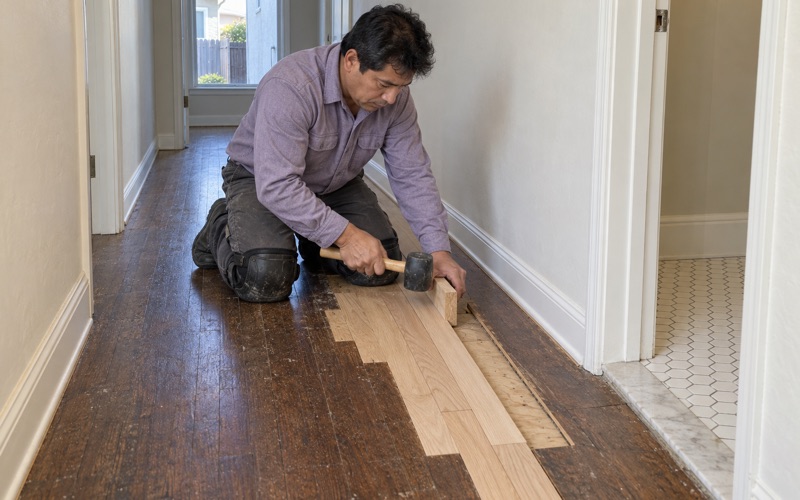
Where a spot fails that test, we open it up and look. We identify what the decking actually is in your home rather than assuming, check whether it has swollen or delaminated, and look at the framing it sits on. Wet or damaged decking gets replaced and the water source gets traced first, whether that is a supply line, a drain or the water heater, so the new floor is not sitting on the old problem.
Moisture Readings Before Material
We take moisture readings with a wood moisture meter in the existing decking and in any wood floor we plan to refinish, and we record each one. New flooring is checked for moisture content when it arrives, and it acclimates in the home until its readings sit within the range the manufacturer and NWFA installation guidelines call for.
Every home holds moisture differently, so a reading taken on day one is only useful if it is written down and compared later. Keeping those numbers is how we catch a problem before the boards start cupping or showing gaps, not after.
Old Tile, Mastic and Paint
Homes from the 1950s through the 1970s can carry older materials under today’s floor covering. If we find old floor tile or black mastic, we treat it as a possible asbestos question and stop before anything is sanded or scraped, since disturbing it falls under SCAQMD Rule 1403 and an asbestos survey answers the question properly.
Anything built before 1978 also calls for lead-safe work practices under the EPA Renovation, Repair and Painting rule when painted surfaces are disturbed, such as trim, thresholds or painted floors. We set up containment, keep lead dust from sanding out of living areas and clean to the standard the rule sets.
Planning Wood or Engineered Floors in a Manufactured Home
Engineered Wood and Floating Floors
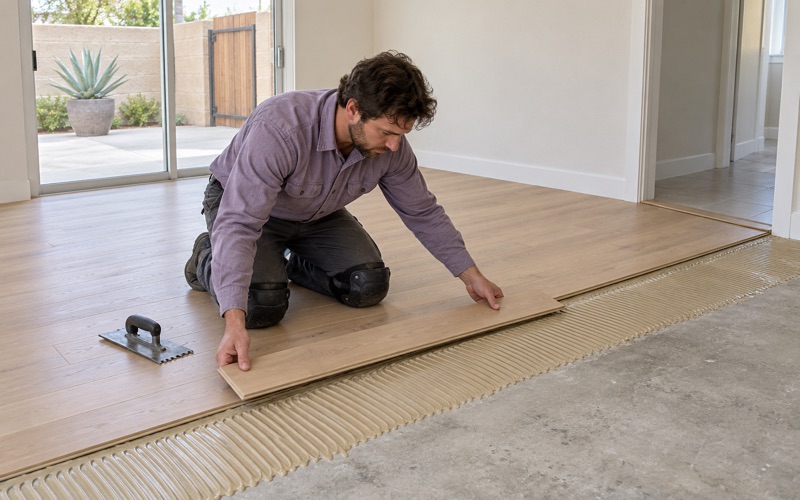
For most manufactured homes we lean toward engineered wood. Its layered core construction handles seasonal movement better than solid boards, and it can go down as a floating installation over sound decking, or glued down where the substrate suits it. A thin wear layer still allows a future screen and recoat, and a thicker one can take a full sanding later.
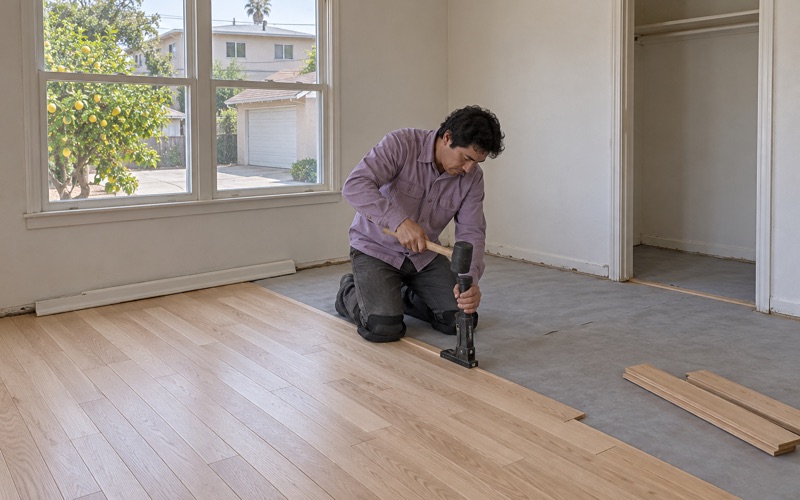
Solid hardwood can work too, but it adds thickness and weight, and nail-down installation depends on what the decking will hold. We make that call only after the decking has been opened and checked, and we explain the trade-off rather than steering you to whichever product is easiest to sell.
Heights, Doors and Transitions
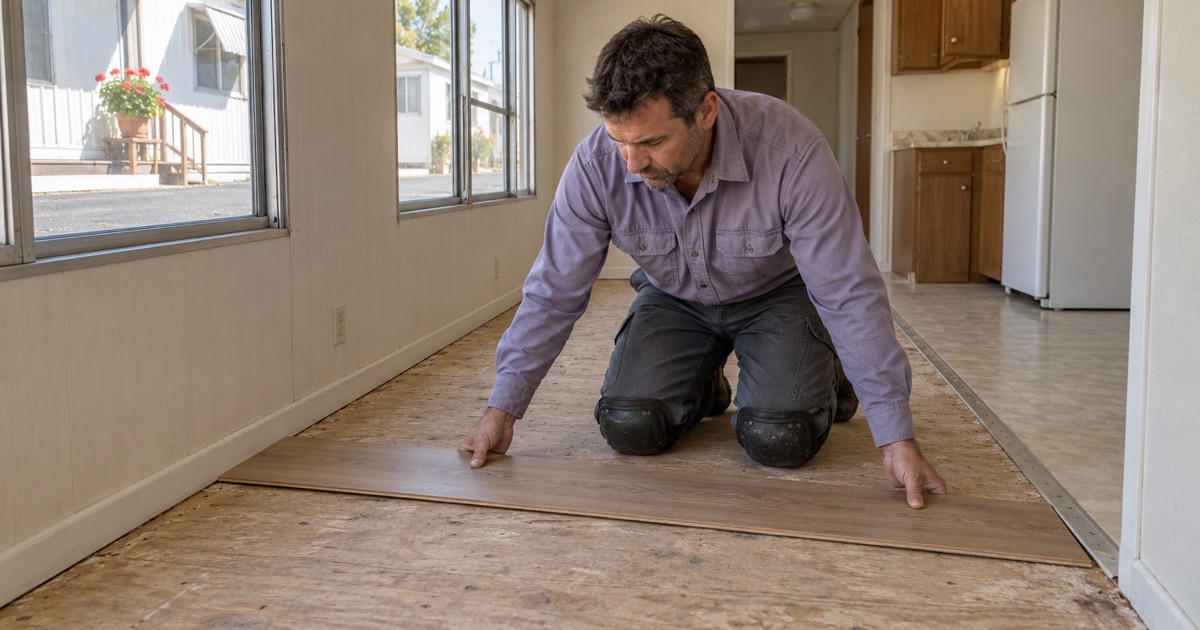
In a manufactured home, clearance at exterior doors, interior doors and cabinet toe kicks is often tight, so floor height matters. We measure every threshold before choosing a product, plan the expansion gap around the perimeter, and use a reducer strip or T-molding where the new floor meets carpet, vinyl or another room. Shoe molding finishes the edges so the gap stays hidden.
A home made of more than one transportable section also has a marriage line where the sections join. We check that seam for level and movement before laying anything across it, because a floor that bridges an uneven joint will show it quickly.
Finishes and Living Through the Work
Whatever wood goes down or gets refinished, we finish it with products legal to apply in the South Coast air basin, where SCAQMD Rule 1113 caps wood coatings at 275 g/L of VOC. A waterborne polyurethane or hardwax oil finish keeps odor down in a smaller home, and we help you pick a sheen level that suits the light and the traffic.
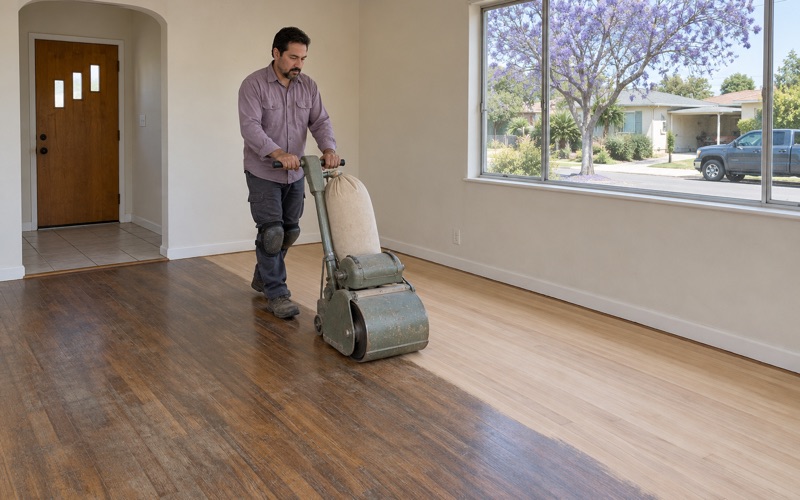
In a compact home there is often no spare room to retreat to, so we work in stages, contain dust with a dustless sanding system where sanding is needed, and hand you a written cure schedule. It spells out when each room can take socks, shoes and finally furniture, so you can plan the week around the work instead of guessing.
- 20+ Years in Business
- Written Moisture Readings
- Lead-Safe Work Practices