
Gardena Wood Flooring handles subfloor repair in Gardena, CA, serving surrounding cities including Alondra Park, West Athens, West Rancho Dominguez, Lawndale and Hawthorne. In more than 20 years of floor work, the callbacks we have seen other contractors get have usually traced back to one thing: a new floor laid over a subfloor nobody opened up.
We check the subfloor before any finish floor is priced. Soft spots, water-swollen decking and damaged joists are found and fixed first, so the wood, tile or vinyl on top has a solid, flat base and the problem does not come back through it a year later.
This page covers the signs of a failing subfloor, the materials we find under floors in this area, how we repair them, and the particular issues with mobile home decking.
Signs the Subfloor Has Failed
Soft Spots and Bounce
A spot that gives underfoot is the clearest sign. It usually means the decking has softened from water, delaminated, or lost its fastening to the joists. Bounce across a wider area can also point to a joist that has cracked or sags between supports.
These spots tend to grow. Walking on softened decking breaks it down further, and eventually the finish floor above cracks or separates along the weak area.
Squeaks and Nail Pops Across a Room
One squeaky board is usually a fastener problem. Squeaks and nail pops spread across a whole room point to the subfloor moving against the joists, either because the fasteners have loosened over the years or because the decking has shrunk and swelled with moisture. We look at the pattern before fixing individual squeaks, because refastening the finish floor does little if the decking underneath is still moving.
Swelling, Stains and Lifting Flooring
Flooring that has lifted, tile that has cracked in a line, or vinyl with a raised ridge often sits over swollen decking. Stains around toilets, dishwashers, sinks and water heaters are a common sign that water has been getting into the subfloor for a while. We take moisture readings with a wood moisture meter in these areas to see whether the leak is still active before opening anything up.
Termite Damage in the Framing
Termite frass, small exit holes or decking that sounds hollow when tapped can mean drywood or subterranean termites have been working in the subfloor or joists. Damage from insects is often worse inside the wood than it looks on the surface.
We probe the affected area to find how far the damage runs, and we ask that the infestation be treated by a pest control company before we replace the decking or sister the joists.
What Is Under the Floor
Plank Decking in Older Houses
Many houses built in the 1940s and 1950s have floor decking made of solid boards laid diagonally or straight across the joists, rather than sheets of plywood. Plank decking is strong when dry, but individual boards can split, rot near a leak, or loosen over time.
Repairs replace damaged boards or cover the area with new plywood fastened to the joists, depending on how much of the decking has failed and what floor will go on top.
Plywood
Plywood is the usual subfloor in later houses and the material we use for most repairs. It holds fasteners well and, unlike particleboard, usually keeps its strength after getting wet and drying out again, unless it has been wet long enough to delaminate.
We check for delamination by probing and tapping the area. Plywood that has separated into layers is cut out and replaced.
Particleboard Subfloor
Particleboard subfloor and underlayment were common in remodels, additions and manufactured homes. It swells when wet and does not shrink back, and swollen particleboard crumbles under fasteners and loses its stiffness. Wherever we find wet or swollen particleboard, we cut it out back to sound material and replace it with plywood, rather than leveling over it and hoping it holds.
How We Repair a Subfloor
Cutting Out Failed Decking
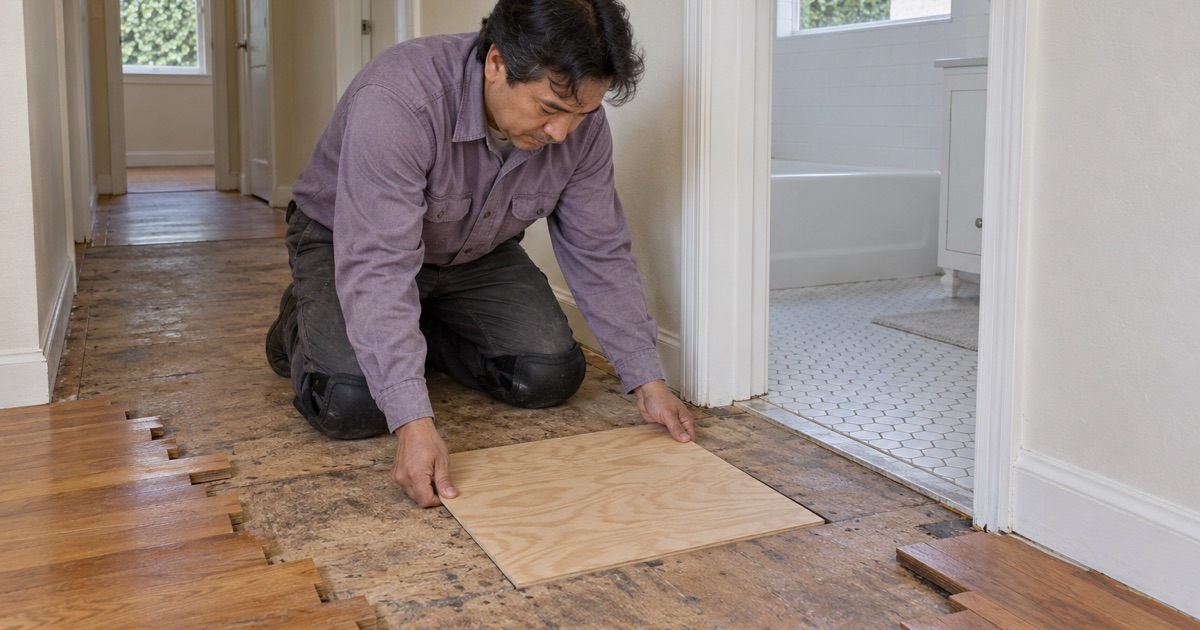
We remove the finish floor over the damaged area, find the edges of the failed decking, and cut back to the nearest joists so the new sheet has solid support on every edge. New plywood is glued and fastened to the framing.
If a leak caused the damage, the source is fixed first and the framing is allowed to dry before new decking goes in. Closing up wet framing only traps the problem.
Joist Sistering
When a floor joist has cracked, sagged, been damaged by termites or been notched too deeply for pipes, we sister it by fastening a new length of lumber alongside it. The two members share the load, and the floor above stops sagging or bouncing.
If we find framing damage beyond a floor repair, such as problems at the cripple wall or sill on a raised foundation, we point it out and recommend the right trade to look at it.
Flattening Before the Finish Floor
A repaired subfloor also has to be flat. We check the patched area and the surrounding floor with a straightedge, grind high spots, fill low ones and add plywood underlayment where needed, following the flatness requirements of the finish floor going on top.
This step matters most where a repair meets old decking. A new plywood patch is rarely the same thickness as worn plank decking or older sheets, and a small step at that seam will telegraph through hardwood, vinyl or tile as a ridge you can feel underfoot.
Mobile Home Subfloors
Particleboard Decking and Title 25
Gardena has more than a thousand mobile homes, and many were built with particleboard decking that softens quickly around bathrooms, kitchens and water heaters. Manufactured housing is regulated under HCD Title 25 rather than the ordinary residential code.
We cut out the failed decking, check the floor framing underneath, and replace it with sound material before any new floor goes down. Because mobile home floors are built differently from site-built houses, we confirm the framing layout before cutting so every edge of the new decking lands on support.
Bathrooms, Kitchens and Water Heater Closets
In mobile homes, the worst subfloor damage usually sits around the toilet, the tub or shower, under the kitchen sink and inside the water heater closet, where small leaks run for months without being seen. The floor covering often hides the damage until the decking gives way.
We check these areas first, confirm whether any leak is still active, and have it repaired before closing the floor back up. Replacing decking while a supply line is still dripping only restarts the damage.
- 20+ Years in Business
- Written Moisture Readings
- Lead-Safe Work Practices