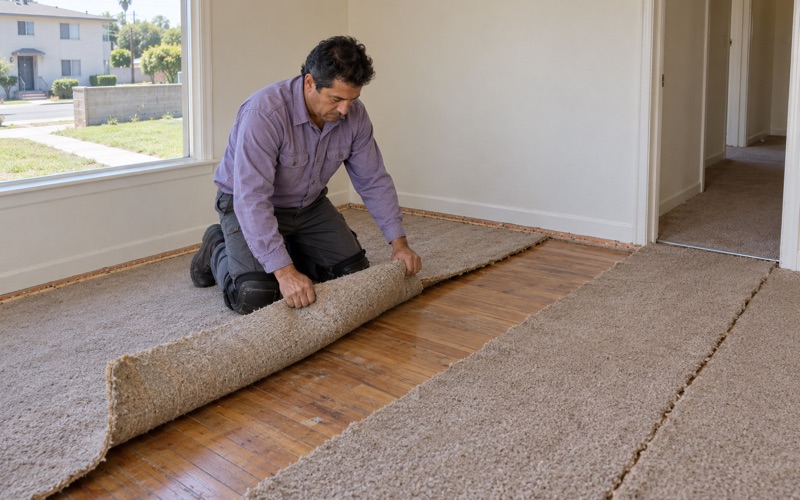
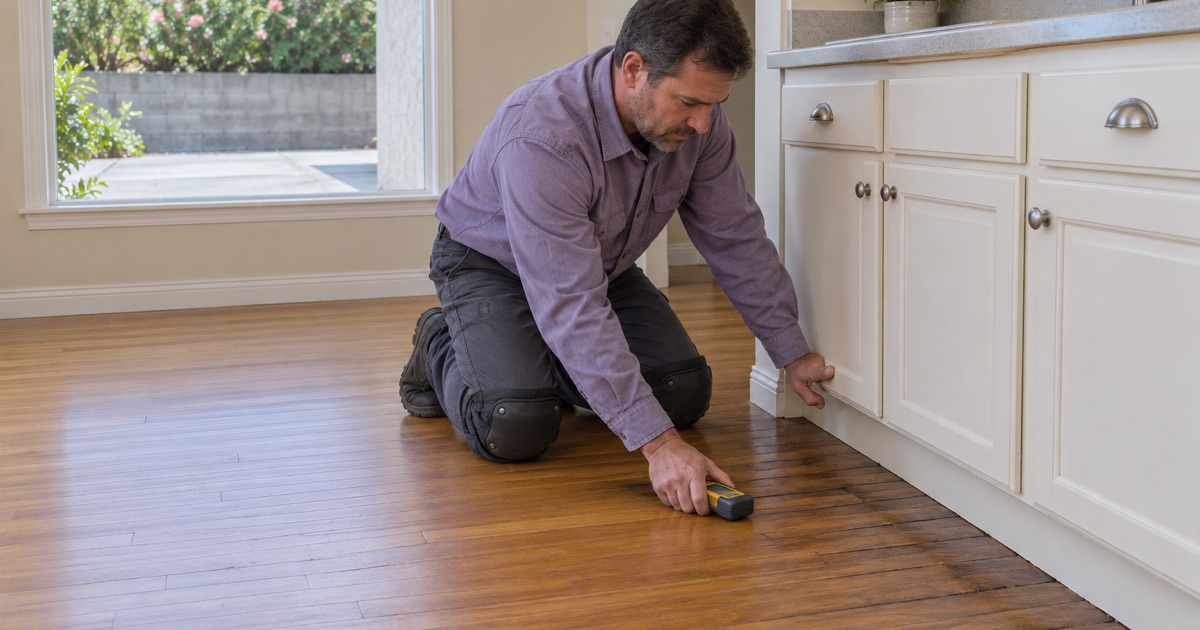
Gardena Wood Flooring has handled wood-flooring in Signal Hill for more than 20 years, and the homes here ask a particular question of us. When a board dips, a seam opens or a hallway feels off, the owner often wonders whether something below the neighborhood is moving. We answer that by looking at the house first, with a level, a moisture meter and the subfloor open where it needs to be.
Our work covers refinishing, board repair, new installation and stairs, and every job starts the same way. We check the floor you have, read the moisture in the wood and in any concrete beneath it, and write the numbers down before a single board is ordered. A repair or refinish answer comes before anyone talks about tearing a floor out, because a sound floor with a tired finish is worth keeping.
Occupied homes get dust containment and a written cure schedule, so you know which room can take foot traffic and which can take furniture, and on which day. Stairs are priced per tread and riser rather than buried in a square-foot figure.
Floors Above a Working Waterflood
What the City Says About the Ground
Signal Hill still produces oil from beneath its streets, and that tends to worry people who are about to spend money on a floor. The city’s own draft safety element is direct on the point that matters: ‘Signal Hill never experienced subsidence.’ The same document says the city does not share the Port of Long Beach area’s subsidence concerns, because the oil field below it lies deeper underground.
Since the 1970s the field has been worked by water injection as a secondary recovery method, which the draft says minimizes the risk of future subsidence. About 97 percent of the liquid pumped from Signal Hill wells is salt water, and that water is injected back down. We mention this to customers not as reassurance we invented, but as the city’s written account of the ground they live on.
A Field That Still Runs
The numbers are large for a city of 2.2 square miles. The draft counts roughly 2,900 wells drilled in the Long Beach Oil Field, about 1,719 of them inside Signal Hill, and records that as of June 2014 approximately 421 active oil or gas wells remained within the city. Those are dated figures, and we quote them with their date rather than as a present count.
For a floor, what follows from all this is modest. A pumping unit down the block is not, by itself, a diagnosis, and we do not treat it as one. When a floor in Signal Hill misbehaves, we go looking for the cause in the house, where cupping, gaps and dips usually have an ordinary explanation we can measure. Our job is the wood, the subfloor and the moisture in the room.
Why We Still Measure
No city document replaces a reading taken in your own hallway. We set a long level or straightedge across the dip, note how far it runs and whether it follows a joist line, a doorway or a wet wall, and record it with photos. A pattern that lines up with plumbing or an exterior wall points one way; a dip centered between supports points another.
Those notes stay with the estimate, so you can see how we reached a price and so the same measurements can be checked again after the repair. It also means a second opinion, from anyone, starts from numbers rather than from a worry about what lies under the neighborhood.
Looking for wood-flooring closer to Palos Verdes Estates? See Palos Verdes Estates Wood-Flooring.
Uneven Floors and Where to Look First
Water Before Anything Else
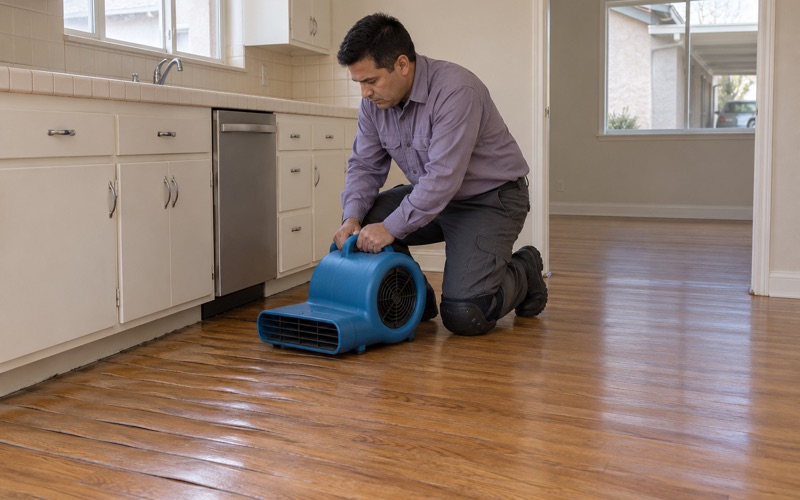
Cupped or crowned boards usually trace back to water, and the source tends to be close by: a dishwasher supply line, a water heater, a leaking toilet seal, or a sprinkler aimed at a wall. We follow the stain and the readings back to where they start, then photograph the damage and log the moisture numbers so an insurance adjuster has something concrete to work from.
A wood moisture meter tells us the moisture content of the boards, and where wood sits over concrete we run an ASTM F2170 in-situ relative humidity test or a calcium chloride test on the slab before anything new goes down. Replacing boards without fixing the water is how a floor cups a second time, so the leak gets found first.
The Subfloor and Framing Underneath
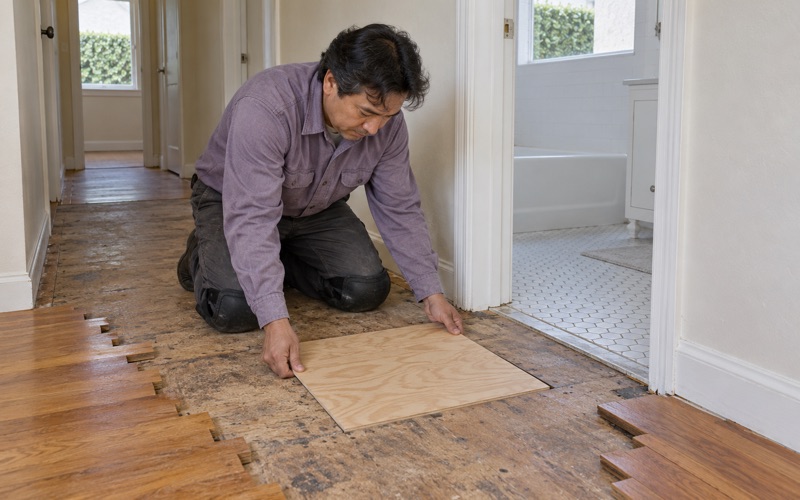
A dip you can feel underfoot is often in the layer below the finish floor. We open the floor and check the decking and any plywood underlayment for soft spots or water swelling, and where joists are reachable we look for cracked, notched or termite-damaged members that let a span sag. Joist sistering or new decking is priced after we have seen it, not guessed at from the surface.
Drywood termites, subterranean termites and powderpost beetles all leave evidence, from frass to hollow-sounding boards, and each changes the repair. Finding that before the finish floor is priced keeps a job from turning into a callback, and it gives you a real answer about why the floor moved in the first place.
Age of the House
Signal Hill’s housing does not follow a single era. The 1980s were its largest building decade, at 23.0 percent of units, yet 48.9 percent of units predate 1980 and 7.3 percent predate 1940. A floor laid in 1985 and one laid in the 1930s fail in different ways, so we ask the year before we guess at the cause.
The 1980s peak matters for planning as much as for diagnosis. A house from that decade postdates the 1978 line that triggers lead-safe practices, yet its subfloor has had four decades to meet a leak or two, so we open and check it just as we would in an older home.
On pre-1978 houses we follow lead-safe work practices under the EPA Renovation, Repair and Painting rule, because sanding can raise lead dust from old finishes and painted trim. Old 9x9 floor tile or black mastic under a floor is treated as an asbestos question, with a survey before anything is scraped or sanded.
Homes That Share a Lot With a Well
Wells Beside Houses
The draft safety element notes that active wells sometimes share parcels with non-oil-related uses, residential uses included. The Signal Hill Municipal Code, for its part, prohibits the drilling of new wells in residential districts. In the 2014 figures, Signal Hill Petroleum owned 347 of the active wells in the city.
For us, a well on or beside the lot is a logistics question rather than a flooring one. The pumping unit, its equipment and the operator’s access routes are not ours to block, touch or move, so we plan where the truck parks, where the sander and dust extractor run, and where boards are staged before the first day.
Staging Work Around the Operation
Interior floor work happens inside the house. What does reach the yard is material delivery, a cutting station and our dust collection, and we keep all of it on the homeowner’s side of any fence or marked boundary. If a well operator has posted access rules for a shared parcel, we follow them and ask before assuming.
The city’s documents describe safeguards at wells near development, such as a float switch that may be required, and a county fire code provision that keeps buildings not needed for a well 100 feet from it. We are not the people to interpret those rules for a given lot, and questions beyond the floor belong with the city.
Who Signs Off on What
Building Safety, within the City of Signal Hill Community Development Department, reviews plans, issues permits and inspects. Since October 28, 2024, that office has been working temporarily out of the Council Chamber at 2175 Cherry Avenue. When a floor repair turns into framing, plumbing or other system work, we raise it with you and check with that office before going further rather than guessing.
Oil operations are governed separately, under Title 16 of the Municipal Code, the Oil Code, with well abandonments overseen by the California Geologic Energy Management Division. That is the operator’s and the city’s territory, and a floor contractor has no business improvising around it.
Planning Floor Work in Signal Hill
Choosing Wood for the House
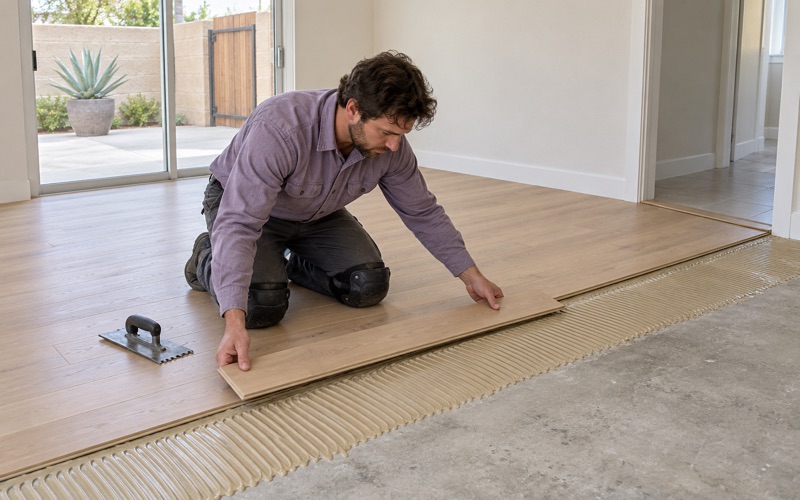
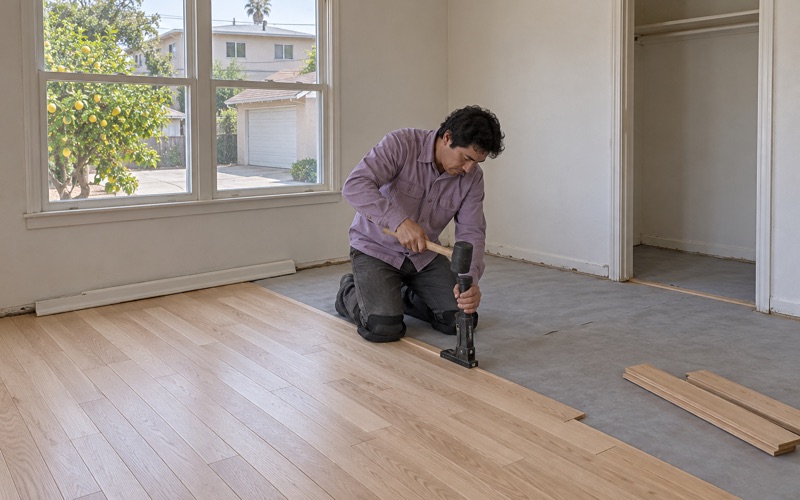
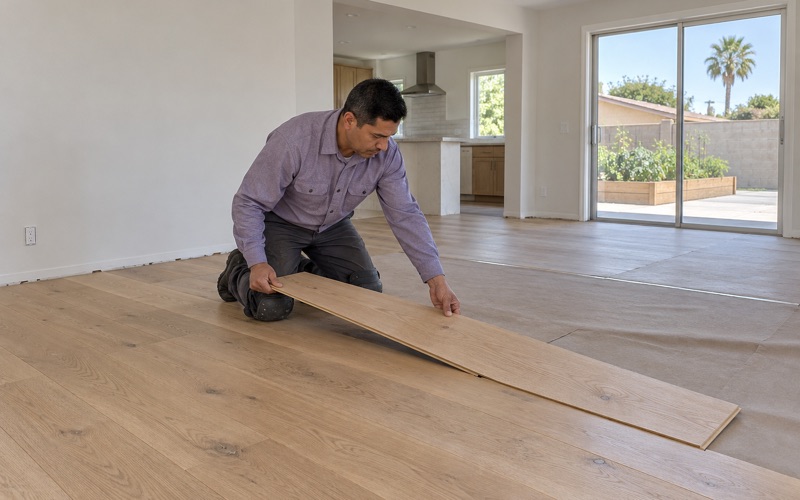
With the cause known, the choice of floor gets simpler. White oak and red oak remain the standard choices for a solid floor that can be sanded more than once, hickory and maple bring more hardness on the Janka scale, and engineered boards with a thick wear layer suit rooms where moisture readings argue against solid wood. We match the installation method, nail-down, glue-down or floating, to what the subfloor can carry.
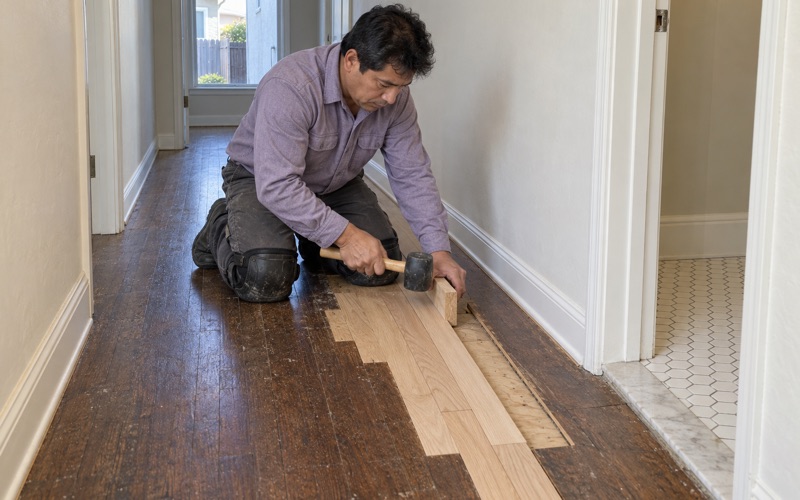
New boards acclimate in the house before they go down, and we follow NWFA installation guidelines on expansion gaps and fastening. A repair that weaves new boards into an existing floor is often the better answer than a full replacement, especially when most of the floor is sound.
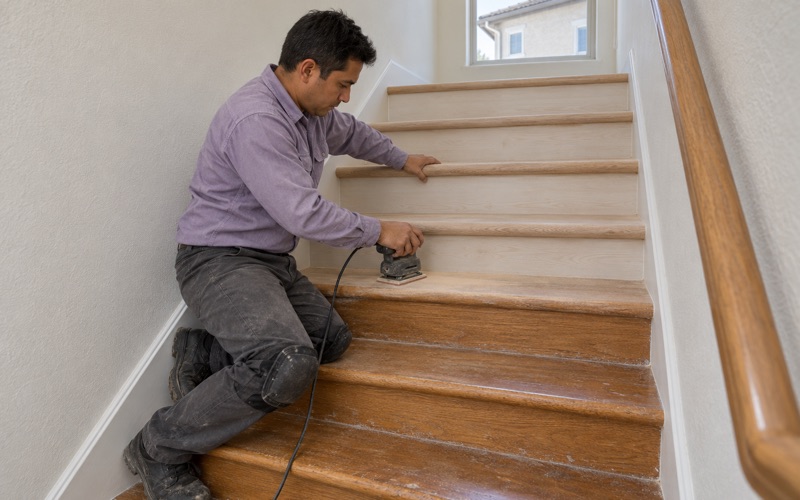
Stairs and transitions get their own attention. We look at each stair nosing and at where treads meet the floor at the landing, and we finish doorway changes in height with a reducer strip or T-molding and the wall edge with shoe molding.
Finishes and the Air Basin
Signal Hill falls within the South Coast Air Quality Management District, and the finishes we apply are chosen from products legal there under SCAQMD Rule 1113 and its 275 g/L limit for wood coatings. Waterborne polyurethane, oil-modified polyurethane and hardwax oil each have their place, and we walk through sheen level and upkeep before the first coat.
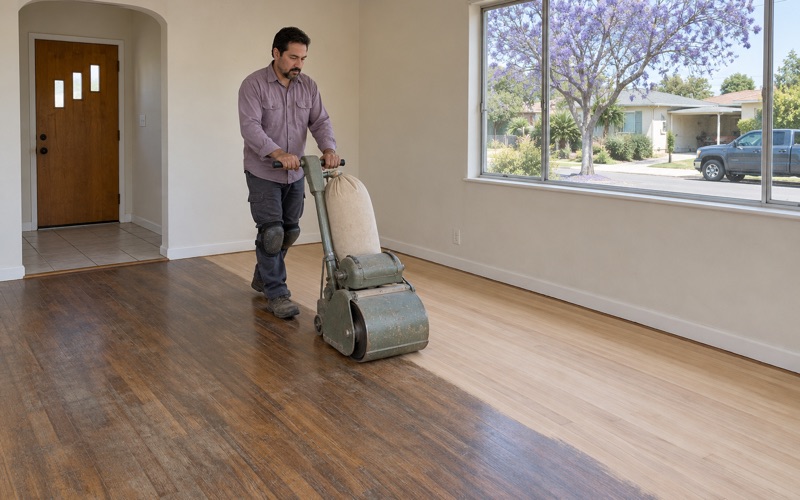
A floor that is worn but not damaged may only need a screen and recoat rather than a full sanding. Where sanding is needed, we work through a proper grit sequence with a dustless sanding system, an edger and an orbital sander, so the result has no sander marks and far less dust in the rest of the house.
Owners, Renters and Turnovers
Signal Hill’s occupied housing splits almost evenly between owners and renters, 50.3 percent to 49.7 percent. For landlords turning over a unit, we handle each unit on its own and provide written estimates and invoices itemized clearly enough to support the repair costs California deposit law asks for under Civil Code 1950.5.
Owners living in the house during the work get a sequence that moves room by room, with containment at each doorway so the rest of the home stays usable. We tell you the evening a room can be walked on in socks and the day it can take furniture, and we write both down.
- 20+ Years in Business
- Written Moisture Readings
- Lead-Safe Work Practices