
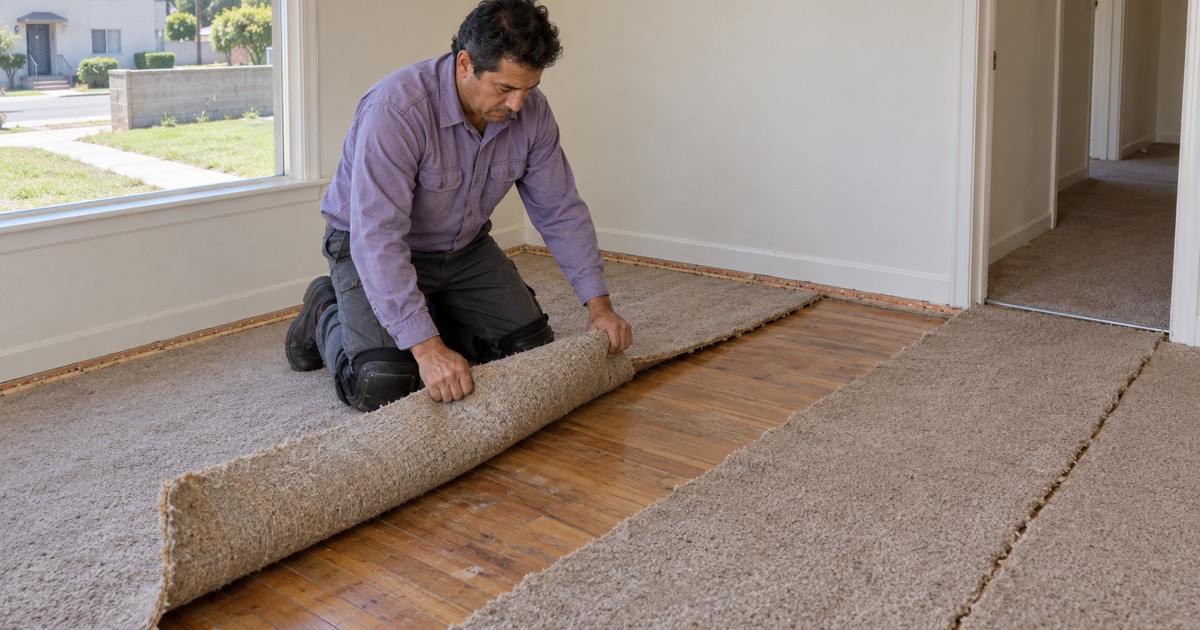
Gardena Wood Flooring helps homeowners replace carpet with hardwood in Gardena, CA, serving surrounding cities including Alondra Park, West Athens, West Rancho Dominguez, Lawndale and Hawthorne. The first thing we do on these jobs is lift a corner of the carpet, because in a lot of houses here the hardwood you want is already underneath it.
The 1950s was Gardena’s biggest decade for new houses, and many of those homes were built with strip oak floors that were later covered with wall-to-wall carpet. When that oak is still sound, refinishing it is usually faster and less expensive than buying a new floor. When it is not there, or is too damaged to save, we install new solid or engineered hardwood instead.
This page covers what you might find under the carpet, what removal can uncover, how we choose the new floor, and what changes in rentals and condominiums. After 20+ years of these projects, we have learned to expect a surprise or two and to price for them honestly.
First, Look Under the Carpet
Original Oak Floors
Many older houses have narrow oak strips under their carpet, often with the original finish still intact where furniture sat. Those floors typically show tack strip holes around the edges, pad staples across the field and some wear or staining in doorways.
If the wood is sound and has enough thickness left above the tongue, we pull the staples, fill the holes, replace any damaged boards with a weave-in repair and refinish the room. The result is a floor that has been in the house since it was built, looking close to new.
Plank Decking or Plywood
Sometimes the carpet sits directly on subfloor: plank decking in older houses or plywood in newer ones. Those surfaces were never meant to be finished and need a new hardwood floor on top.
Before installing, we check the subfloor for soft spots, water damage and loose areas. Replacing carpet is the best chance to fix subfloor problems, since the floor is already open.
Concrete Slab
Many houses and ground-floor units sit on a concrete slab-on-grade, with carpet laid over the concrete. We test the slab with an ASTM F2170 in-situ relative humidity test or a calcium chloride moisture test before recommending a product.
Engineered hardwood is usually the right choice on a slab, glued down or floated depending on the readings. The readings also decide whether a vapor retarder or moisture-blocking adhesive is needed.
Removal and What It Uncovers
Carpet, Pad and Tack Strip
We remove the carpet, pad and tack strip and haul them away. Taking up tack strip carefully matters when there is hardwood underneath, because prying it off roughly splits board edges around the room.
Pad staples can number in the thousands across a house. Every one comes out before sanding, since a missed staple will tear a sanding belt and gouge the floor.
Old Tile and Black Mastic
In kitchens, hallways and entries, carpet sometimes covers older 9x9 floor tile or black mastic adhesive left from a previous floor. Both can contain asbestos in houses of this age.
We stop and recommend an asbestos survey before anything like that is scraped, sanded or ground. If it tests positive, removal is handled under SCAQMD Rule 1403 before our flooring work continues in that area.
Damage the Carpet Was Hiding
Carpet hides pet urine stains, old water damage and termite damage. Once it is up, we look for dark stains in the wood, soft spots in the subfloor and signs of insects along the walls.
We show you what we find and price any repairs before continuing. Stained boards are cut out and replaced; soft decking is opened and rebuilt so the new or refinished floor sits on solid ground.
Choosing the New Floor
Solid Hardwood on a Wood Subfloor
On a raised foundation with sound decking, solid hardwood nailed through the tongue gives the longest-lasting floor and can be sanded many times over its life. Species choice comes down to hardness, color and budget, with white oak and red oak the most common choices.
If part of the house already has original oak and another part does not, we can lay new strip oak of the same width in the rooms that need it and refinish everything together. Sanded and finished as one floor, old and new boards blend far better than they would if finished separately.
Engineered Hardwood on a Slab
On concrete, engineered hardwood is more stable and needs no built-up subfloor. We compare products on wear layer thickness, because that decides whether the floor can be sanded and refinished later.
A glued-down engineered floor feels solid underfoot and sounds much like solid wood, while a floating floor installs faster and can go over some existing surfaces. We recommend one or the other based on the slab readings and how the room is used, not just the quickest install.
Heights, Doors and Transitions
Carpet and pad compress, while hardwood does not, so door clearances and transitions change. We measure before installing, trim doors where needed, and use a reducer strip or T-molding where the new floor meets tile, carpet or another room. Shoe molding along the baseboards covers the expansion gap at the walls and gives the room a finished edge.
Rentals, Condos and Lead-Safe Work
Rental Turnovers
Many landlords replace carpet with hardwood between tenants, because wood is easier to clean and lasts through more turnovers. We work unit by unit and put estimates and invoices in writing, separated by room, so owners have clear records for each unit.
For a unit with a short vacancy window, we can often refinish original oak or lay prefinished engineered wood without a long cure period, so the unit is ready to show sooner. We give the owner a schedule for each unit up front so the next lease date can be set with confidence.
Condominium and HOA Rules
Civil Code 4760 covers alterations inside a condominium unit, and many associations have rules about hard flooring and the underlayment required beneath it. We ask for those rules before quoting and choose an installation that meets them.
Some associations want the product and underlayment approved in writing before work starts. We provide the product documentation the board asks for, so approval does not hold up the job once the carpet is already out.
Houses Built Before 1978
In a house built before 1978, removing carpet and baseboards and sanding a floor can disturb old lead paint on the trim. We follow lead-safe work practices under the EPA Renovation, Repair and Painting rule, with containment and a careful cleanup, so dust stays out of the rest of the house.
- 20+ Years in Business
- Written Moisture Readings
- Lead-Safe Work Practices