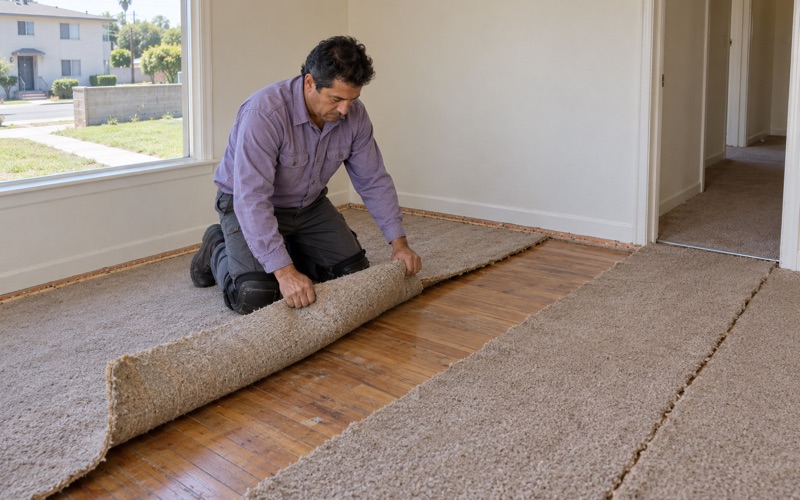
Gardena Wood Flooring has spent more than 20 years on wood-flooring work, and wood-flooring in La Palma is a job we approach from the inside of the house out. We repair, refinish and install hardwood for owners who want their floors done right, with the subfloor checked and the moisture measured before anyone quotes a price. Our first answer is usually whether a worn floor can be saved, because replacement is the most expensive option on the table.
That inside-out view matters here for a specific reason. The city keeps a close eye on how homes look from the street, but what happens on the floors behind the front door is left to the people who live there. Nobody schedules that work for you, and the city grant once offered for home repairs has no funding today, so the plan and the budget start with the owner.
This page walks through what La Palma’s code enforcement does and does not cover, what happened to the relief grant, and how we help owners plan floor work on their own terms. It ends with the practical side of working in houses from the 1960s and 1970s, where lead, old tile and finish rules shape the job before a sander ever starts.
How La Palma Enforces Property Maintenance
What Code Enforcement Looks At
La Palma’s Code Enforcement staff work to make sure the city’s municipal codes and property maintenance standards are met. The division sits inside the Community Development Department alongside Planning and Building & Safety, and it handles residential property maintenance, graffiti, inoperable vehicles and commercial violations. For homeowners, the residential side is the part that comes up.
Every item on the city’s residential list is outside the house: poor landscape maintenance and overgrown yards, deteriorated fencing, broken windows, storage in the front yard, inoperable vehicles and visible debris. The division surveys residential neighborhoods for unsightly exterior conditions, and the city describes its approach as working with owners to reach compliance rather than punishing them. You can reach the office at (714) 690-3342.
The Relief Grant That Lost Its Funding
For owners who received a violation, the city once had a way to help. Its Residential Code Enforcement Relief Program provided a grant of up to $10,000 so low-income homeowners could bring their homes up to the city’s minimum standards. The Code Enforcement Division managed the program and told residents about it when violations were issued.
The money came from redevelopment. When Governor Brown signed AB1X 26, known as the Dissolution Act, new redevelopment activity was suspended and redevelopment agencies were dissolved, and the program’s funding went with them. The city says alternative funding has not been identified, so the grant is not something an owner can count on today, whatever the repair.
Looking for wood-flooring closer to Los Alamitos? See Los Alamitos Wood-Flooring.
Why the Inside of the House Is the Owner’s Call
No City Checklist Stops at the Front Door
Because the residential list is all exterior, code enforcement is not the reason anyone in La Palma refinishes a floor. A cupped board in the hallway or a finish worn through in front of the kitchen sink is invisible from the sidewalk, and nothing on the city’s residential list touches it. The standard for the inside of the house is the one the owner sets.
That freedom cuts both ways. There is no deadline forcing a rushed job, but there is also no notice reminding anyone that a scratched finish is letting water into the wood. Floors tend to get attention when something else prompts it, such as a sale, a new baby, a returning family member or a room that finally gets cleared out.
Reading the Warning Signs
Since no one outside the household will flag a floor problem, it helps to know what to watch for. Cupping, where board edges rise above the centers, and crowning, the reverse, both point to a moisture imbalance somewhere. Buckling, where boards lift off the subfloor, is more serious and usually means water has been at the floor for a while.
Seasonal board gaps that open in dry months and close in damp ones are normal wood movement, but gaps that stay open year-round are worth a look. Squeaks and nail pops usually trace back to loose fastening or a subfloor that has moved. We diagnose the cause first, whether it is a leaking line, a lifted board or failing decking, so the repair fixes the source rather than the symptom.
Repair or Refinish Before Replace
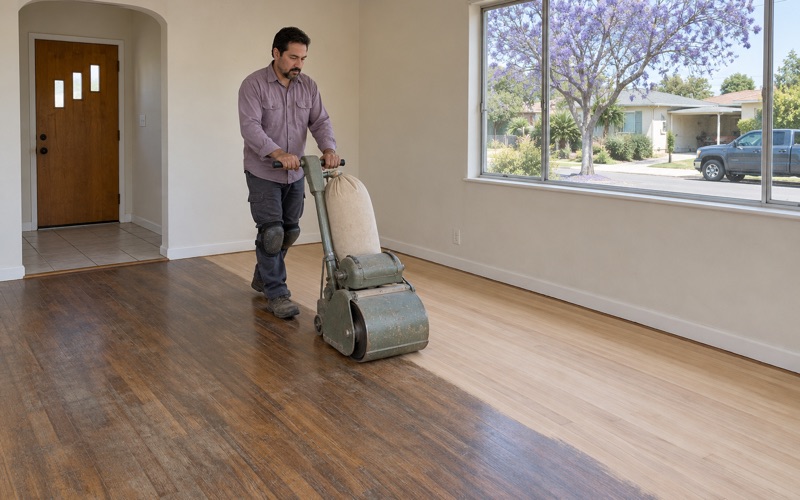
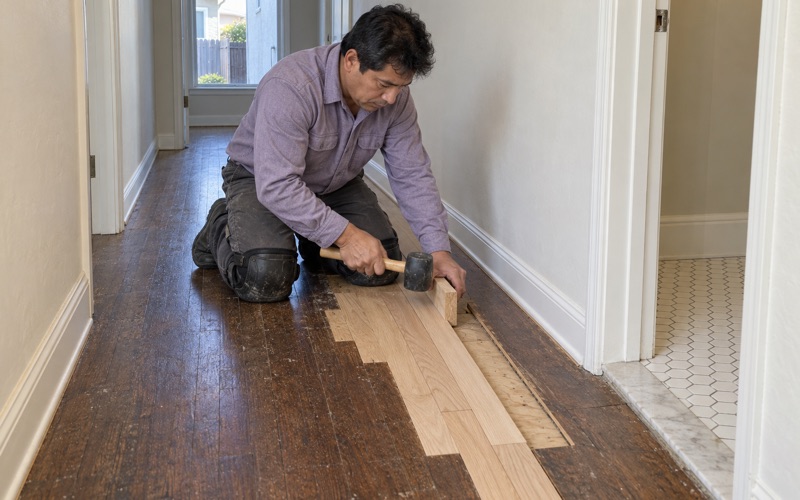
When an owner calls us, we start by asking whether the floor can be kept. Many worn floors need a screen and recoat, a few board replacements or a weave-in repair where a wall or cabinet once stood, not a new floor. We check the wear layer thickness on engineered boards before promising a sanding, because a thin veneer can only be sanded so many times.
Solid hardwood usually has more life in it than its surface suggests. Gray traffic lanes, pet urine stains near a back door, peeling polyurethane and old sander marks are the common complaints, and most of them come out with a proper grit sequence and a fresh finish. If a board is too far gone, we replace that board and blend it rather than tearing out the room.
Planning and Paying for Floor Work in La Palma
Without a grant in the picture, a floor project in La Palma gets paid for the way most home work does: from savings, a planned budget or a phased schedule. Our job is to make the numbers solid enough to plan around, so the price an owner budgets for is the price the work actually costs.
Estimates Built on What We Find
We open and check the subfloor before pricing any finish floor. Soft spots, water-swollen decking, a failing particleboard subfloor or a floor joist that needs sistering are far cheaper to find at the estimate than halfway through an install. When the floor needs structural attention, the estimate says so in writing, with the repair listed separately from the flooring.
Moisture gets the same treatment. We take readings with a wood moisture meter, and where new flooring will go over concrete we test the slab, using an ASTM F2170 in-situ relative humidity test or a calcium chloride moisture test depending on the job. The readings are written down before material is ordered, and the boards acclimate on site until their moisture content is where the NWFA installation guidelines want it.
Phasing the Work to Fit a Budget
An owner paying out of pocket does not have to do the whole house at once. We can price room by room, refinish the living areas this year and the bedrooms later, and match sheen level and stain so the second phase does not look like an afterthought. Stairs are priced per tread and riser, so a staircase can be its own line item rather than a surprise buried in a square-foot number.
Phasing also keeps the house livable. We set up dust containment around the rooms in progress and hand over a written cure schedule, so everyone knows when each room can take foot traffic and when furniture can go back. Families who stay in the house during the work can plan meals, sleep and pets around dates instead of guesses.
When Replacement Is the Right Call
Sometimes a floor is past saving, and then the choice of material drives the budget. Red oak and white oak remain the workhorse species, hickory and maple bring more hardness on the Janka hardness rating for homes with big dogs or heavy traffic, and walnut is softer and chosen for its color. Wide plank, herringbone pattern and chevron pattern layouts all add labor and belong in the estimate from the start.
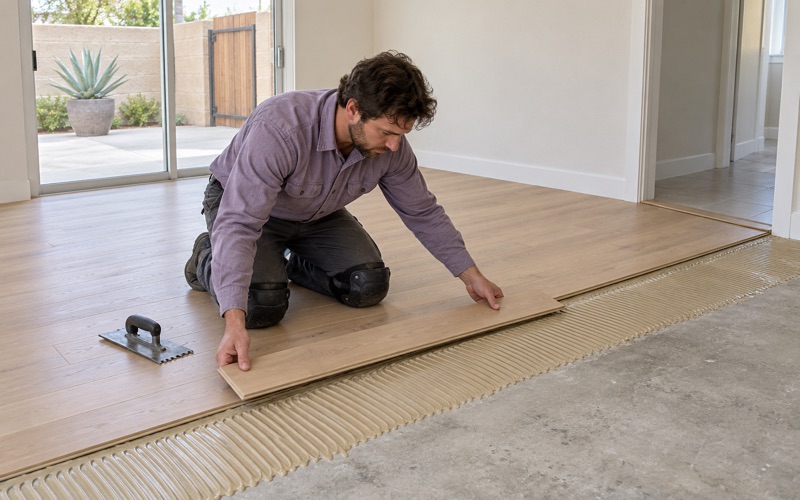
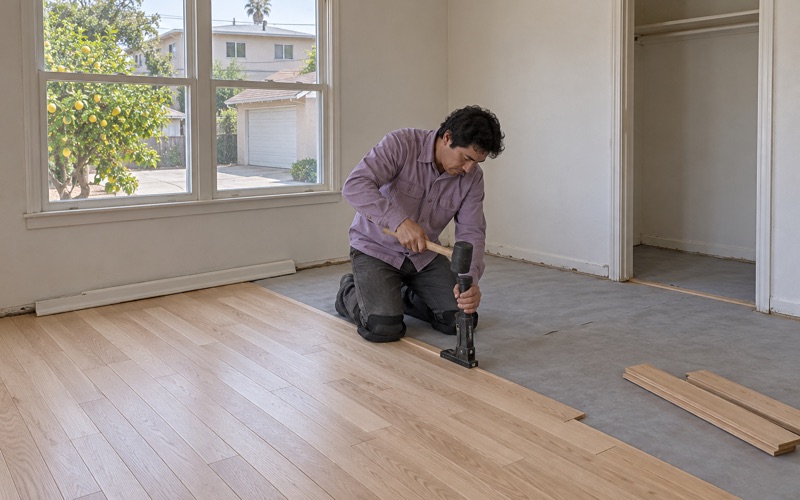
Engineered core construction handles concrete better than solid wood and can go down as a glue-down installation or a floating installation, while solid boards over a wood subfloor are typically a nail-down installation with cleat nails or flooring staples. We leave the correct expansion gap at the walls and finish the edges with shoe molding, T-molding and reducer strips so every transition sits flat.
Floors in La Palma’s 1960s and 1970s Houses
The ACS 2024 five-year estimates count 5,206 housing units in La Palma, and 75.6 percent of them were built in the 1960s and 1970s. Among owner households, 90.1 percent live in detached houses. That era shapes how we prepare a job before any floor is touched.
Lead-Safe Sanding in Pre-1978 Houses
A house built before 1978 may have lead paint on baseboards, door casings and shoe molding, and sanding a floor beside that trim can spread lead dust through the room. We follow EPA Renovation, Repair and Painting rule practices on pre-1978 housing: the work area is sealed off, trim is protected or removed with care, and cleanup is done to the rule’s standard rather than with a shop broom.
We run a dustless sanding system connected to the drum sander, edger and orbital sander, which cuts down what escapes the room in the first place. In a house of this age we treat every painted surface near the floor as a question to answer before the first pass, not something to deal with once dust is already on the windowsills.
Old Tile and Black Mastic
Houses from the 1960s and 1970s sometimes carry older resilient flooring under carpet or newer vinyl, including 9x9 asbestos floor tile and the black mastic that held it down. Neither can be identified by looking at it, so we treat them as a possible asbestos question and recommend an asbestos survey before anything is sanded, scraped or ground.
Disturbing that material is governed by SCAQMD Rule 1403, which is why the survey comes first. If the results are clear, we proceed with removal or install over the old layer as the plan calls for. If they are not, the abatement is handled properly before our crew returns, and the new floor schedule is built around that step.
Finishes That Meet South Coast Rules
La Palma sits in the South Coast Air Quality Management District, which covers all of Orange County. Under SCAQMD Rule 1113, wood coatings carry a VOC limit of 275 g/L, and every finish we apply is chosen from products legal to use in the basin. That rules out some older solvent-heavy products, but it leaves plenty of good options.
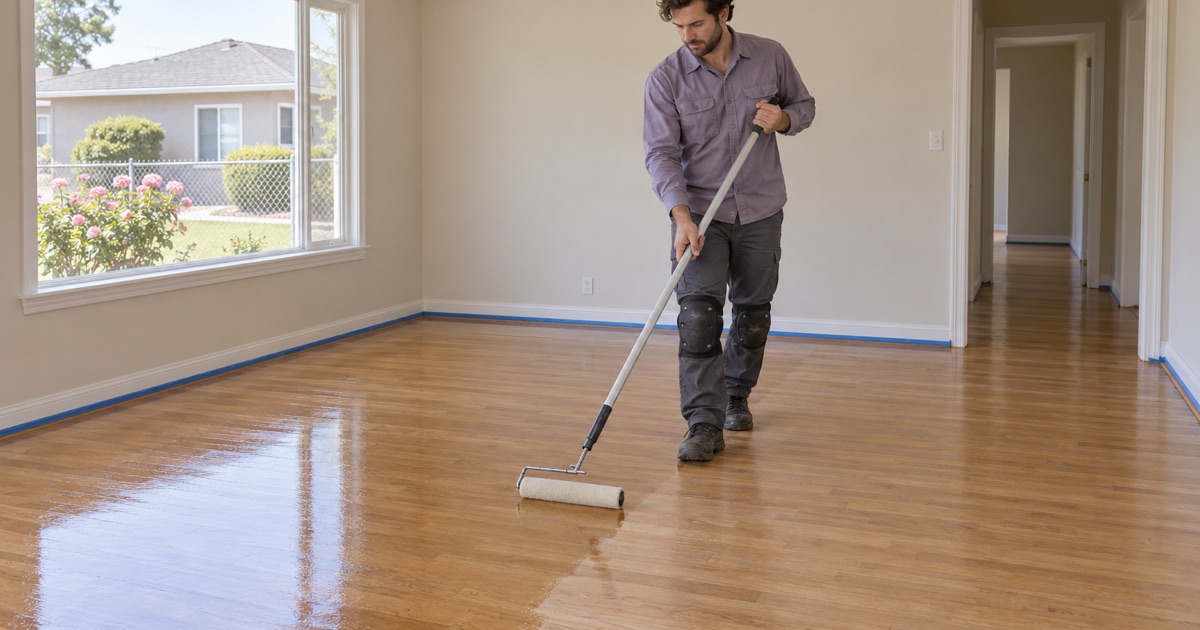
Waterborne polyurethane dries clear, stays light on oak and returns a room to use quickly, which suits a family living around the work. Oil-modified polyurethane gives a warmer amber tone, and a hardwax oil finish appeals to owners who prefer a matte look they can spot-repair. We walk through the trade-offs and the cure times before the owner picks one.
- 20+ Years in Business
- Written Moisture Readings
- Lead-Safe Work Practices