
Gardena Wood Flooring handles hardwood floor water damage in Gardena, CA, serving surrounding cities including Alondra Park, West Athens, West Rancho Dominguez, Lawndale and Hawthorne. Over 20+ years we have repaired floors wet by dishwasher lines, water heaters, refrigerator icemakers and slab leaks, and the jobs that go wrong are almost always the ones where someone repaired the wood before finding the water.
So we start with the source. We trace where the water came from, map how far the moisture spread through the boards and subfloor, and document all of it with readings and photos. Only then do we decide what can dry in place, what has to come out, and what the repair will cost.
This page covers what to do in the first hours, how we trace a leak, how we decide between drying and replacing, and how our records help when an insurance claim or a landlord is involved.
The First Hours After a Leak
Stop the Water and Clear the Floor
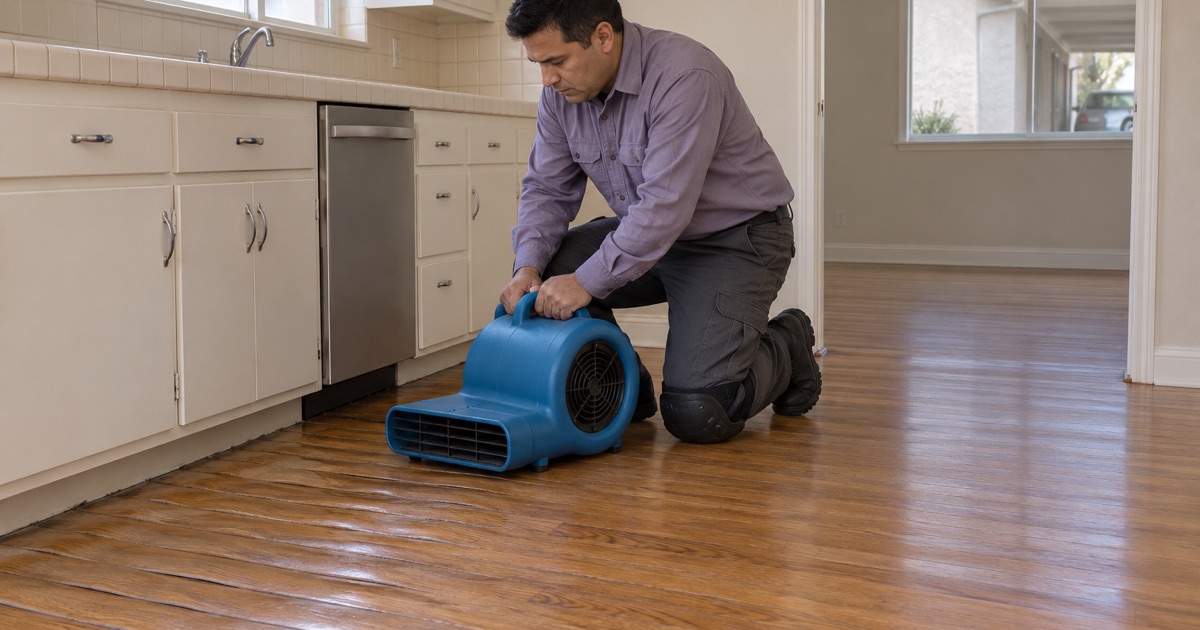
The first step is always shutting off the supply to whatever is leaking, whether that is the valve under the sink, the dishwasher supply, or the cold line to the water heater. Then move rugs, furniture and boxes off the wet area and mop up any standing water.
Wood keeps absorbing water for as long as it sits on the surface, and rugs hold it against the boards. Getting everything off the floor quickly is the single biggest thing a homeowner can do to limit the damage.
What Not to Do
Do not cover the wet floor with plastic sheeting, which traps moisture in the boards. Avoid aiming strong heat at the floor, which can dry the top of the boards faster than the bottom and make cupping worse. And do not sand, scrape or refinish anything until the floor has been measured and has dried.
It is also worth photographing the area before anything is moved or cleaned up, including the leaking fixture. Those first photos are often the clearest record of what happened.
Measuring Where the Moisture Went
Water travels under hardwood farther than the visible stain shows. We use a wood moisture meter across the floor and on the subfloor where it can be reached, marking the edge of the wet area room by room.
That moisture map tells us how much of the floor is actually affected, which boards may dry and which will not, and gives a baseline to measure drying against. The readings are written down with the date and time.
Tracing the Source
Dishwashers, Sinks and Icemaker Lines
Kitchen water damage most often starts at a dishwasher supply line or drain connection, a sink supply line, or the thin plastic icemaker line behind a refrigerator. These leaks are often slow, so the floor may have been wet for weeks before anyone noticed cupping or a dark edge along the cabinets. We pull the appliance where needed to confirm the source and check the subfloor under the cabinets, where water collects out of sight.
Water Heaters
A water heater in a closet or garage next to a finished floor can leak from the tank, the relief valve line or the connections on top. When a tank fails, the water often runs under the wall and into the nearest room before it shows. We check the pan and the floor around the heater, and follow the readings along the wall line to see how far the water reached into the next room.
Slab Leaks
When the wet area is in the middle of a room with no fixture nearby, or the floor over a concrete slab is warm to the touch, the cause may be a slab leak in a supply line under the concrete. The wood will keep taking on water until that line is repaired.
We document the pattern and recommend a plumber with leak detection equipment to confirm and repair the line. Floor repairs wait until the slab has been fixed and has dried, which we confirm with testing rather than time.
Dry, Repair or Replace
Drying the Floor in Place
Floors that were wet for a short time, with boards that are cupped but not split or loose, can often be dried in place. Drying equipment and airflow bring the moisture down, and we take readings through the process until the boards and subfloor match the unaffected parts of the house.
A cupped floor usually flattens considerably as it dries. Whatever unevenness remains can then be sanded and refinished once the readings are stable.
Cupping, Crowning and Buckling
Cupping, with raised board edges, means the underside of the floor is wetter than the top. Buckling, with boards lifting off the subfloor, means the floor took on enough water to push against itself and the walls.
The worst outcome is crowning, which happens when a cupped floor is sanded flat before it has dried. As the boards finish drying, their centers end up higher than their edges, and that damage cannot be undone. That is why we never sand a wet floor.
Replacing Boards and Subfloor
Boards that are split, blackened, delaminated or no longer holding their fasteners are cut out and replaced with a weave-in repair of matching species and width. Where the water reached the subfloor, we check the floor decking and joists underneath.
Particleboard subfloor that has swollen does not recover and is cut out and replaced with plywood. Plywood that dried without delaminating can usually stay. Once the base is sound and dry, the new boards go in and the repaired area is sanded and finished to match.
Engineered and Floating Floors
Engineered boards can swell at the core before the surface shows much damage, and floating floors often trap water in the underlayment beneath them. Both usually need to be lifted in the affected area so the subfloor or slab underneath can dry. Matching engineered flooring can be difficult years after installation, so if you kept spare cartons, let us know before we order replacements.
Insurance, Landlords and Documentation
Records an Adjuster Can Use
For every water damage job, we keep a record of the source, the moisture readings across the affected area with dates, photos of the damage before and during the work, and a written scope of what needs to be dried, repaired or replaced and why.
An adjuster reviewing a claim needs to see where the water came from and what it affected. Handing over measurements and photos rather than a verbal description makes that review faster and leaves less room for dispute.
Working Alongside Your Insurer
California’s claims regulations, including 10 CCR 2695.9, set standards for how insurers handle repair and replacement on property claims. We do not interpret your policy or tell you what it covers, but we can meet the adjuster on site, walk through the readings and answer questions about the repair. If the adjuster’s scope and ours differ, the records we kept are what we use to explain why.
Rental Units and Landlords
In rental buildings, water damage often needs to be repaired between tenants or while a unit is occupied. We work unit by unit and provide written estimates and invoices that separate each repair and its cost, which a landlord can use for their own records or a deposit accounting.
When the leak happened while a tenant was living there, the moisture readings and source record also help separate damage caused by a failed fixture from damage caused by use. We record what we find without taking sides, and the landlord decides what to do with it.
For occupied units, we plan drying and repairs so the tenant keeps as much of the unit usable as possible, and we give both the owner and the occupant a written schedule for when each room will be worked on.
- 20+ Years in Business
- Written Moisture Readings
- Lead-Safe Work Practices