Gardena Wood Flooring brings more than 20 years of experience to wood flooring in Commerce, where many homes share their blocks with freight lines, truck routes and warehouses. That setting changes how a floor wears. The boards just inside the front door take a steady stream of grit from busy streets, and the finish on them works harder than it would on a quiet cul-de-sac.
Our approach starts with the wood itself. We tell you whether a worn floor needs a full sanding or only a fresh topcoat, we measure moisture content in the boards before ordering anything, and we choose finishes from products legal to apply in the South Coast air basin. A floor that has lasted in the family for decades is one we try to keep.
This page covers what matters most for a Commerce house: why its setting shapes floor care, what the city’s Green Zones Policy set out to do, how to pick and maintain a finish under heavy foot traffic, and what an owner should check before building on land that once held industry.
Homes Among Rail Yards and Industry in Commerce
A City Built Mostly for Goods Movement
Commerce is an unusual place to own a house. By the city’s own Green Zones Action Plan, most of its land is devoted to commercial, industrial and goods-movement uses, and heavy rail yards and two major state highways cut through it. People live there too, in neighborhoods tucked between those corridors.
The city incorporated in 1960 to keep Vernon and Los Angeles from annexing its industrial land, and the Long Beach and Santa Ana freeways serve it today. For a homeowner, that history means trucks, trains and loading yards are part of daily life, and a floor inside the door feels the effect in wear long before it shows its age anywhere else.
Houses From the 1940s and 1950s
Commerce’s housing is old and small in number. Census figures count 3,381 units across 6.534 square miles, and 52.2 percent of them were built in the 1940s and 1950s. Only 3.6 percent date from 2000 or later, and none were counted from 2010 onward. Among owners, 86.9 percent live in detached houses.
A floor in a house that age may have been sanded several times already, so we check how much wood remains above the tongue before promising another full sanding. Pre-1980 homes make up 72.9 percent of the stock, which means lead-safe work practices under the EPA Renovation, Repair and Painting rule can apply, and old 9x9 tile or black mastic under a floor is treated as a possible asbestos question before anything is scraped.
Repair Before Replacement
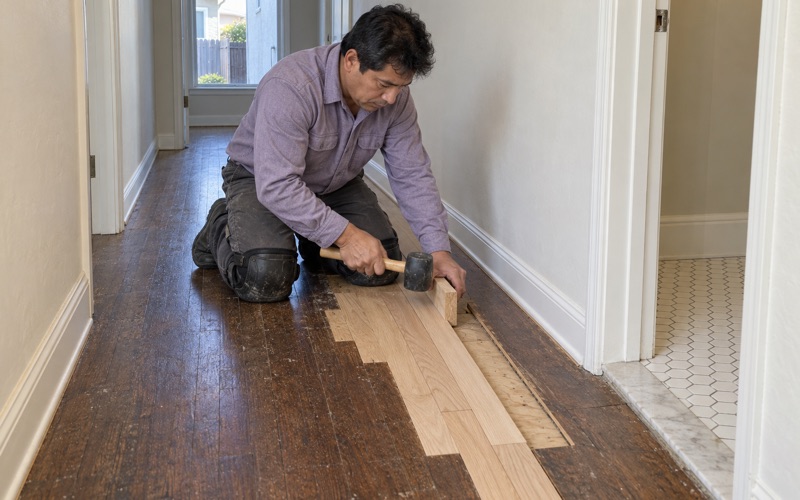
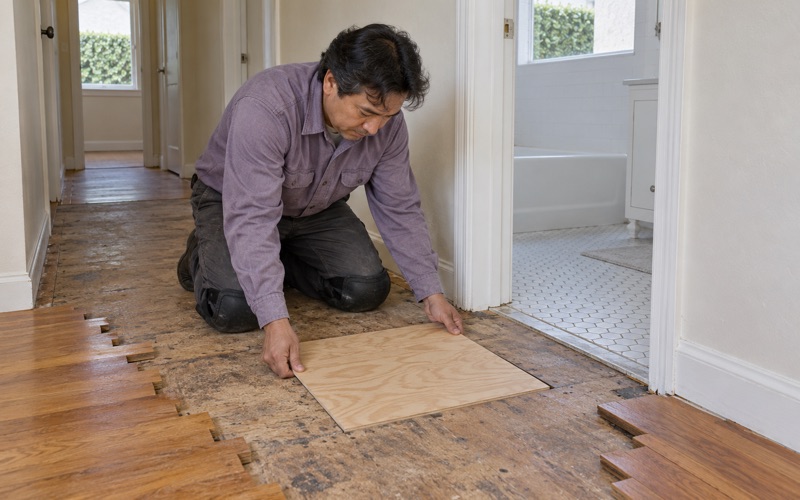
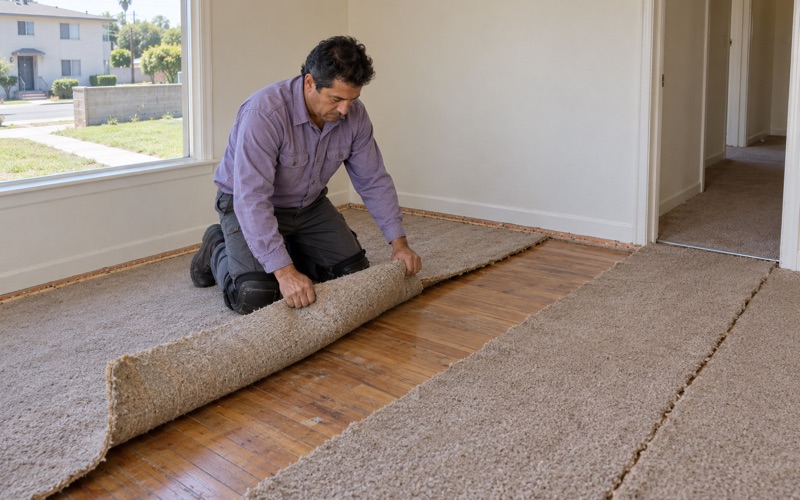
A floor in a mid-century house may have lived through patches, carpet and earlier refinishes. We open and check the subfloor before pricing any finish floor, so soft spots, water-swollen decking or a failing joist turn up before they become callbacks. Damaged boards can often be cut out and replaced with a weave-in repair that follows the existing pattern.
When a floor has water damage, we trace it to the source first, whether a dishwasher line or a water heater, and document the readings and photos an insurance adjuster can use. Only when the boards cannot be saved do we talk about replacement, and then we match species, width and thickness as closely as the existing floor allows.
Looking for wood-flooring closer to Artesia? See Wood-Flooring Services in Artesia.
What the Green Zones Policy Set Out to Do
A Unanimous Council Vote
Living beside industry is a question the city has taken up directly. In November 2013, East Yard Communities for Environmental Justice recommended that the City Council prevent toxic exposure by amending the zoning laws, and the Council voted unanimously in favor of a Green Zones Policy that came out of a working group the city sponsored.
The framework rests on several pillars: reduction, reinvestment, revitalization, and prevention of toxic exposure from new projects and land uses. The prevention piece recommends restricting new toxic land uses near homes, schools, churches and senior centers. The Green Zones Action Plan was prepared with the City and the U.S. Environmental Protection Agency, along with residents, businesses and technical experts.
What It Does Not Tell a Homeowner
We read the policy as a statement of direction rather than a rulebook for a single lot. The sources we have describe its aims, not a buffer distance or an ordinance number, so we don’t quote either one. If you are weighing a purchase or an addition, the city’s planning staff are the people to ask how the policy applies to a given parcel today.
What the policy does confirm is the setting our crews work in. Homes here already stand beside the heavy uses the policy was written about, and that closeness is why we plan each Commerce job around the entry, the traffic path and the finish, rather than treating the floor as if it sat on a quiet hillside street.
Grit, Wear and Recoat Timing on a Hard-Used Floor
Stopping Grit at the Door
Grit acts like sandpaper under a shoe. Each step grinds fine particles into the topcoat, and on a floor near busy streets the first visible damage is usually a dull, gray lane from the front door toward the kitchen. The fix starts outside the wood: a coarse mat outdoors, an absorbent mat inside, and a habit of leaving work boots at the entry.
Inside, felt pads under chair legs and a dry microfiber mop used often do more than any cleaning product. We advise against wet mopping and steam, which push water into seams and can raise the grain or lead to cupping. Those small routines decide whether a finish lasts years or starts wearing through within a season.
Choosing a Finish for Heavy Traffic
Every finish we apply in Commerce has to meet the South Coast Air Quality Management District’s Rule 1113 limit of 275 grams per liter for wood coatings, so the choice is among compliant products. For a hard-used entry and hallway, we usually recommend a two-component waterborne polyurethane, which cures hard, stays clear and holds up well to abrasion.
Oil-modified polyurethane is still an option in a compliant formula, though it ambers over time and takes longer to cure. A hardwax oil finish is easier to spot-repair but needs more frequent maintenance. Sheen matters too: satin and matte hide fine scratches and grit marks far better than gloss, and the species helps, since a harder wood by Janka hardness rating such as hickory or maple resists dents better than red oak.
Recoating Before Wear Reaches the Wood
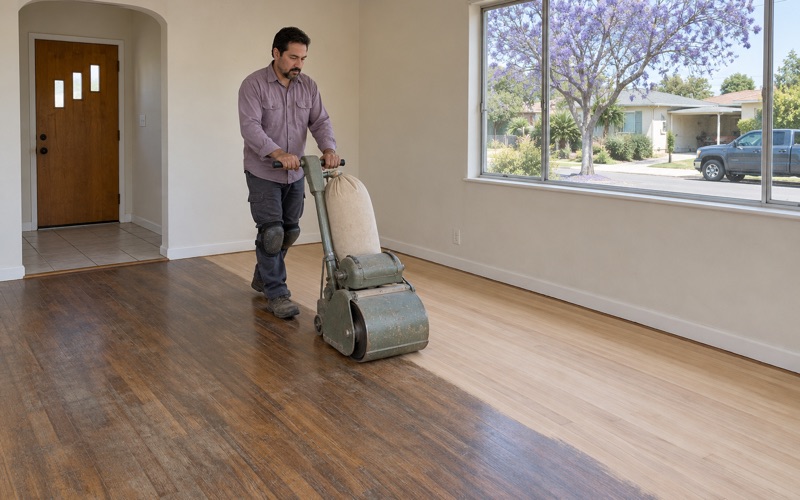
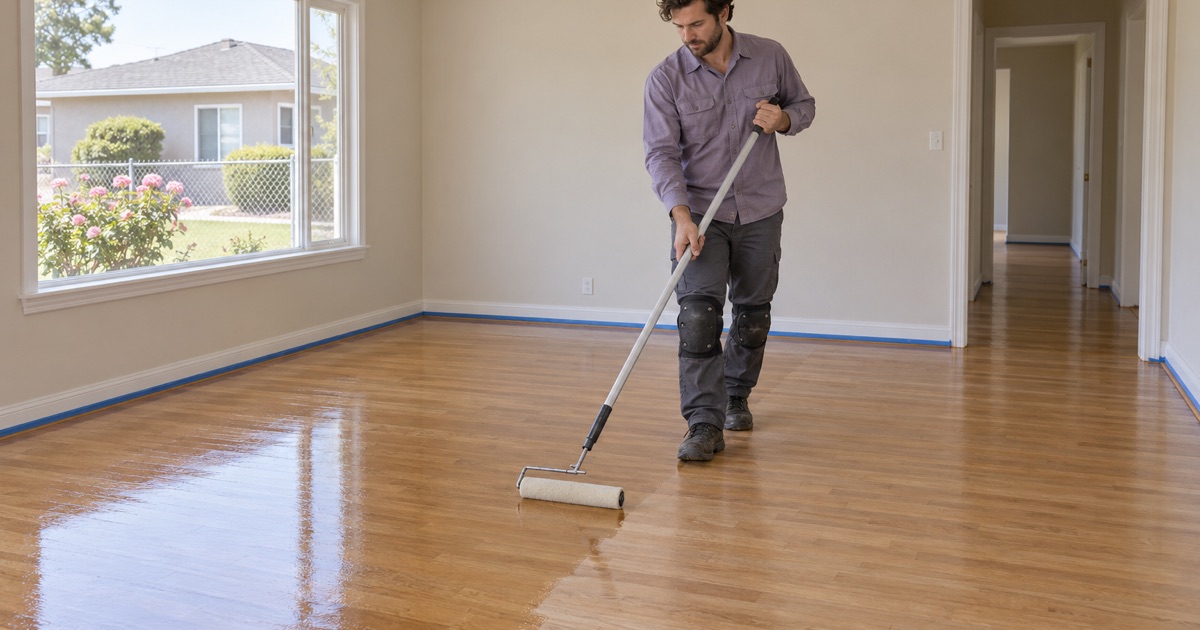
The least costly refinish is the one done early. When the traffic lane has dulled but the finish is still intact down to the wood, a screen and recoat lightly abrades the existing topcoat and adds fresh coats without sanding to bare wood. It takes a fraction of the time and removes no wood from the boards.
Once grit wears through to gray, bare wood, a recoat will not bond evenly there, and the floor needs a full sanding through a grit sequence with a drum sander, an edger and a buffer. On a busy Commerce entry, we suggest checking the traffic lane each year and planning a recoat every few years, before that point arrives. We also check for a prior wax or polish, which must be removed before any new coat will adhere.
Building on Former Industrial Land in Commerce
What the State’s Toxics Agency Flagged
Because so much of Commerce has served industry, a new home or addition may go up on ground with a past. In a July 9, 2024 letter on the city’s 2021-2029 Housing Element, the California Department of Toxic Substances Control wrote that the plan’s scope encompasses multiple active and nonactive mitigation and cleanup sites where it has conducted oversight, and that this may restrict what construction is permissible.
The same letter said that, because of the plan’s broad scope, the agency could not determine where the proposed sites were or whether any carried documented contamination or land use restrictions. That uncertainty is the reason we don’t point to any particular address. It is also why an owner should look into a lot’s history before new construction begins, rather than after.
Checks Before New Construction
If you are planning an addition, a new unit or a new building on a lot that once held an industrial use, ask the City of Commerce Building and Safety Division and the planning staff what applies to that parcel before you commit to a design. Plans submitted from January 1, 2026 are checked against the 2025 California codes, including the Residential Code. We also suggest asking whether the parcel appears on any state list of hazardous materials sites.
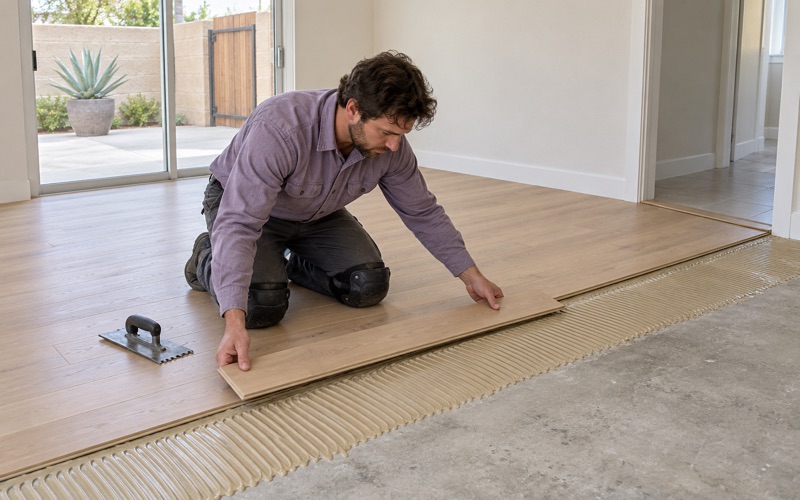
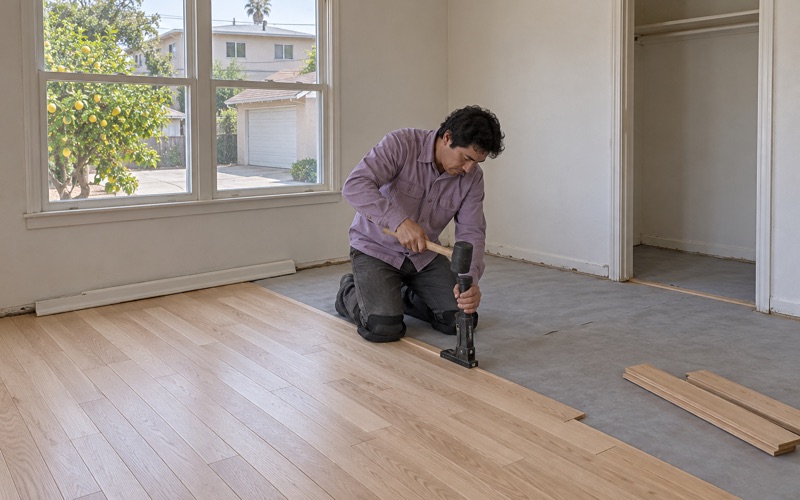
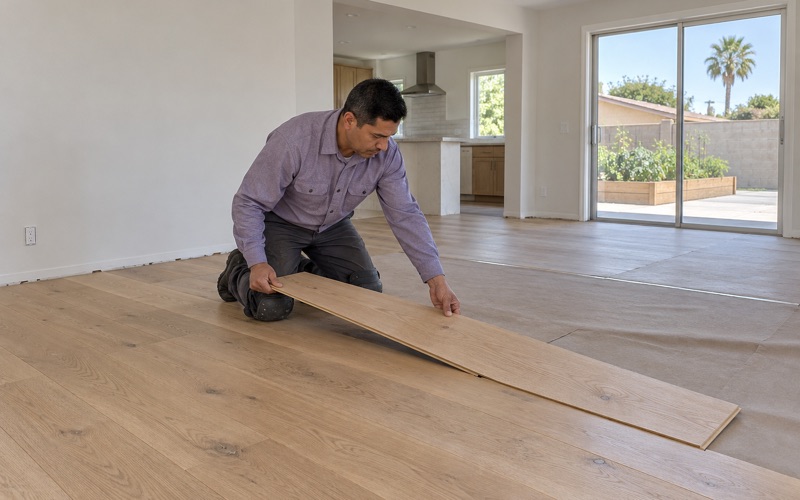
For the wood floor itself, new construction brings its own moisture question. Fresh concrete and framing lumber hold water, so we test with a wood moisture meter and, on concrete, with an ASTM F2170 in-situ relative humidity test or a calcium chloride test before any flooring is delivered. Boards then acclimate on site, and we follow NWFA installation guidelines with a vapor retarder where the substrate calls for one.
Occupied Homes During the Work
Floor work in an occupied home needs a plan for the people living there. We contain sanding dust with a dustless sanding system and plastic barriers, and we seal off the rooms we are not working in. Every job ends with a written cure schedule, so you know when each room can take socks, then shoes, then furniture and rugs.
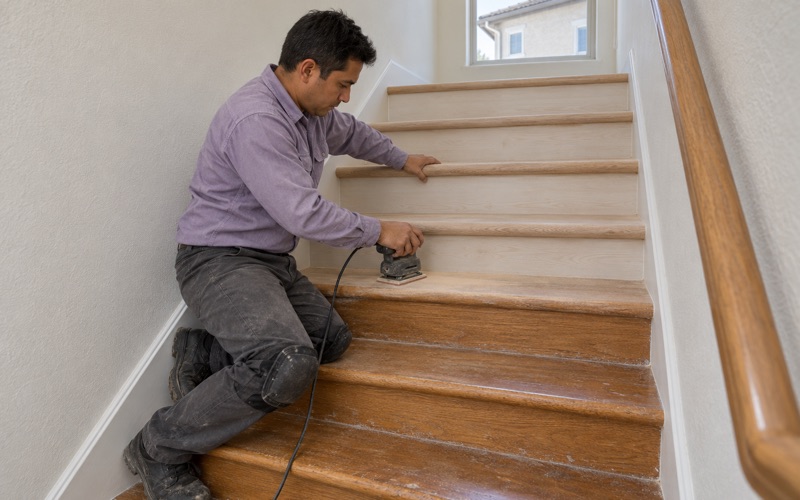
Stairs are priced per tread and riser rather than folded into a square-foot figure, since each tread is sanded and finished on its own. We give written estimates before work starts, so the scope, the finish and the schedule are settled in writing rather than remembered.
- 20+ Years in Business
- Written Moisture Readings
- Lead-Safe Work Practices